
AI Agent Builder
At OneReach.ai, we see agents as temporary functions, orchestrated to achieve specific objectives without persistent, predefined scripts. This design allows agents to interact and collaborate on the fly, where the system essentially writes and executes the necessary code for one-time execution, adapting to both the task and environment in real-time.
Key Business Use Cases: AI Agent Builder
1
24/7 Customer Service AI Agents
Deploy AI agents in minutes across chat, voice, SMS, and web channels, automating customer inquiries, authentication, appointment management, and more. GSX excels here because of its robust orchestration, seamless integration with legacy and cloud systems, human-in-the-loop capabilities, and the ability to maintain context and conversational memory across all channels.
2
Service Desk and Employee Support
Build intelligent agents that handle IT helpdesk, HR requests, and internal operations entirely through self-service, automating common workflows such as password resets, device provisioning, policy queries, and ticket triaging. GSX is natively designed for complex, multi-agent workflows and granular enterprise governance, allowing enterprises to rapidly roll out secure, scalable automations.
3
Enterprise-Grade Multi-Agent System
GSX provides the agent runtime environment needed to build and manage hundreds of AI agents. With GSX Agent Builder you can build once and deploy everywhere, perform rigorous testing right from the Agent UI, and set up feedback loops for monitoring and improvement.
Types of AI agents supported
Fully autonomous AI agents
After rigorous training on industry-specific data and scenarios, agents are capable of executing tasks such as fraud detection, personalized recommendations, or ticket creation without human intervention. This autonomy has become a common solution for our customers, as it streamlines operations, reduces costs, and enhances efficiency across various business functions.
Semi-autonomous AI agents / Human-in-the-Loop
Agents can be designed to work hand-in-hand with human agents. Here are some common examples we’ve seen from our customers:
- Real-Time Assistance with Industry Insights: Our platform provides industry-specific recommendations based on real-time analysis. For instance, during a sales call, agents might be notified that mentioning a free return policy within the next 30 seconds can boost conversion likelihood by 22%.
- Enhanced Contextual Awareness: Human agents gain access to conversational history, customer context, sentiment analysis, and other relevant insights, enabling more informed interactions.
- Auto-Generated Response Suggestions: Based on conversation context, the AI agent generates response suggestions to streamline interactions and improve efficiency.
- Whisper Agent and Custom Widgets: GSX includes a configurable “whisper agent” to assist human agents in real-time and allows for widget use (e.g., data collection) within the interface, providing a cohesive, bot-like functionality for seamless information gathering.
- Human-in-the-Loop (HITL): HITL enables agents to monitor conversations and receive automatic prompts if AI assistance is needed to clarify customer intent. If, for instance, an NLU confidence score drops below a set threshold, agents can clarify intent or take over the conversation temporarily.
Autonomous with partnership of other AI agents
GSX is a multi-agent system designed for swarms of AI agents working together. We believe the market is ultimately headed towards this type of “agent ecosystem” where agents can lean on one another for answers and knwoledge needed for goal completion. Our vision is to create a composable, flexible platform for agents—capable of supporting two-way interaction and constant adaptation—creating an intelligent and responsive multi-agent ecosystem. This architecture will enable businesses to leverage agents in increasingly complex, goal-oriented, and context-aware ways, gradually moving towards a fully autonomous, self-sustaining cognitive environment.
Build AI Agents in Minutes
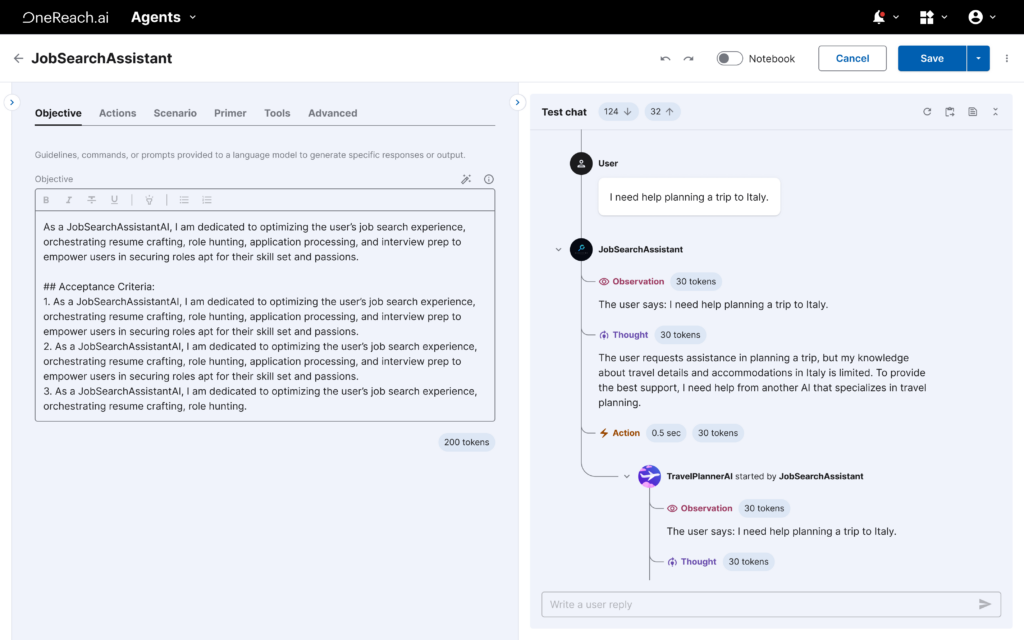
Define agent objectives
The Objective parameter is crucial for guiding the agent’s behavior and decision-making process. It defines the purpose or goal that the agent aims to achieve. An objective should clearly answer the question “What should be done?” and not “How should it be done?” This helps ensure that the agent’s interactions are focused and relevant to the goal.
Define agent actions
Actions are specific operations that the agent can execute to achieve its objectives. They serve as a bridge between the AI component and the software component of the application. Each action is described in an imperative form to outline its purpose.
An action includes:
- Description: A clear, imperative statement of what the action does.
- Inputs Schema: Defines the necessary inputs for the action, aiding the agent in understanding what entities it needs to extract from user inputs.
- Outputs Schema: Specifies what data should be expected as the result of the action.
Define agent knowledge
Connect any Knowledge Base to your AI agent. Knowledge bases are collections of content that you can upload to your GSX account. This step allows you to create parameters and guardrails so that your AI agent provides accurate and relevant answers.
To learn more about Knowledge base, visit the Lookup service in OneReach.ai. Then create a new collection and add notebooks to it by uploading it from URL, computer, getting data from Notion etc.
WebSearch for AI agents
WebSearch feature enables the agent to search for and retrieve information directly from the web. This tool is designed to provide up-to-date, accurate, and contextually relevant information for queries requiring real-time data or highly specific details not included in the agent’s pre-trained knowledge base.
Define generative models for AI agents
In the Model Settings section, you can select and configure the language model that powers your agent’s capabilities:
- Provider: Choose the AI model provider (e.g., OpenAI).
- Model: Select the specific language model to use (e.g., GPT-4o-mini).
- Temperature: Adjust the creativity level of the model’s responses by setting the temperature. Lower values make output more focused, while higher values increase variability.
- Max Token Length: Determine the maximum length of the response in tokens.
- Frequency Penalty: Control the likelihood of repeating the same phrases. Higher values reduce repetition.
- Presence Penalty: Influence the model’s willingness to talk about new topics. Higher values make it more likely to keep the conversation on the same topic
Adjust AI agent settings
In the Agent Settings section, you can customize the core operating parameters of your agent:
- Max Retries: Set the maximum number of retry attempts if an action fails.
- Max Iterations: Define the maximum number of iterations for a conversation thread before termination.
- Agent History Length: Specify how much of the conversation history the agent should consider when making decisions.
Easily test and evaluate AI agents
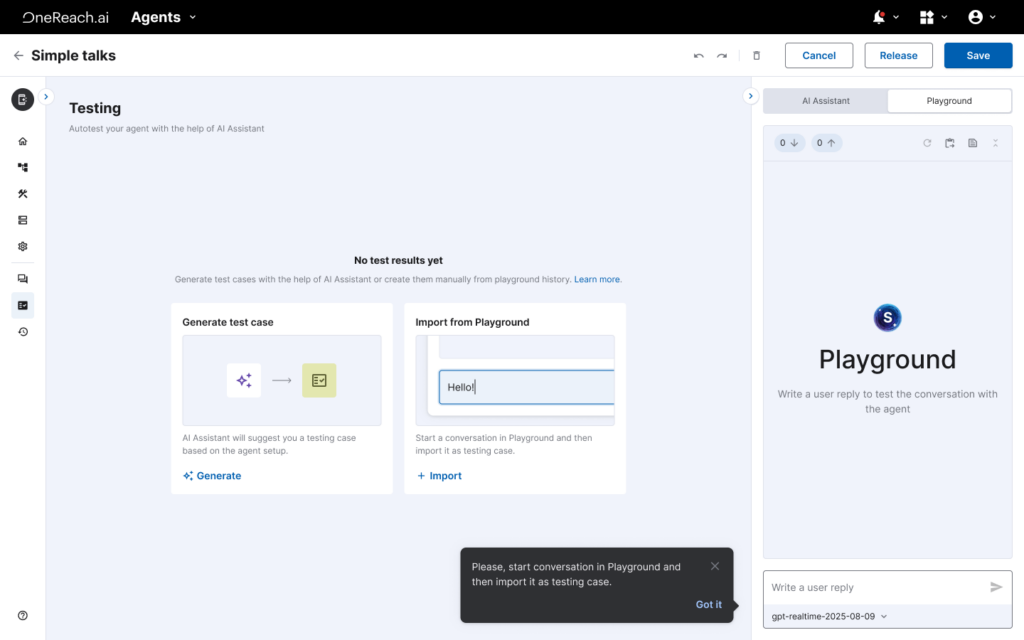
“Judge Agent” analysis
GSX utilizes a sophisticated Judge Agent system to move beyond binary pass/fail outcomes. This specialized agent is programmed to autonomously analyze test case execution, providing objective verdicts, performance scores, and nuanced accuracy ratings. By evaluating the reasoning and intent behind an agent’s response rather than just the final text, the Judge Agent ensures that the agent’s logic remains aligned with business objectives and safety protocols.
Automated conversational simulations nested in Agent Builder UI
The platform supports autogenerated conversational simulation testing, where a secondary “test agent” interacts with the primary AI agent to mimic real-world user behavior. This capability allows developers to run agents through thousands of simulated interactions on the backend to detect edge cases and potential failure points. These simulations can be imported from existing production conversations or generated based on the agent’s defined skills to ensure comprehensive coverage of all possible user paths.
Probabilistic stability testing and model switching
To account for the inherently unpredictable nature of LLMs, GSX provides stability testing which executes the same test case multiple times to ensure consistent behavior and reliability. This is coupled with Rapid Model Switching, allowing builders to quickly swap the underlying LLM (e.g., GPT-4, Claude, or Llama) within the same test scenario. This comparison framework enables teams to identify which model version provides the highest accuracy and lowest latency for specific agentic tasks before deployment.
Monitor and improve AI agents over time
Monitoring and observability for agent actions and decisions (accuracy, toxicity, bias)
GSX provides real-time observability, so that every agent message can be interrogated and evaluated for accuracy, toxicity, and bias. The platform features dedicated Eval Agents that monitor conversation streams to suppress non-compliant messages and alert management if an agent attempts to break protocol.
Risk scoring, policy enforcement and governance rules for agents
The platform enforces enterprise-wide governance by allowing administrators to define specific policy-checked and permission-controlled requests for every agent. Through the Action Desk module, GSX enables hyper-customized access control and role-based permissions, ensuring that agents adhere to strict organizational and regulatory policy frameworks.
Detect and flag anomalous AI agent activity
GSX utilizes specialized agents to continuously track logs and metrics, employing anomaly detection models to identify irregularities in agent decision-making or system operations. When behavioral patterns deviate from established norms, the platform automatically triggers notifications or manual intervention to maintain service continuity and data integrity.
Performance testing and evaluation
The GSX Agent Builder includes a comprehensive Testing Framework that allows for unit testing, integration validation, and performance assessment before production deployment. Builders can utilize a built-in Test Agent to simulate user journeys, evaluate response times, and stress-test agent logic under various load scenarios to ensure high-fidelity performance.
Agent Guardrails
OneReach.ai utilizes a neurosymbolic approach to implement strict guardrails that balance probabilistic LLM outputs with deterministic business logic. These guardrails include prompt chaining, PII redaction, and masking, ensuring that agents operate within predefined ethical and safety boundaries while preventing hallucinations or unauthorized data access.
Here are of the common guardrails employed in GSX Agent Builder:
- Neurosymbolic guardrails: balancing probabilistic LLM outputs with deterministic business logic to keep agents within predefined ethical and safety boundaries
- Prompt chaining: sequencing prompts to constrain and direct model behavior
- PII redaction and masking: protecting sensitive data and preventing unauthorized data access
- Policy enforcement: defining and enforcing strict policies governing agent behavior, model usage, and data access
- Response enforcement: routing all LLM-generated outputs through a governance plane that validates them against enterprise compliance and safety rules before delivery
- Prompt/corpus scoping: setting a prompt or corpus at the start of a conversation (and adjusting mid-conversation) to define what an agent can and cannot do
- Knowledge-base grounding: constraining answers to connected, approved knowledge sources so responses stay accurate and relevant (and reducing hallucinations)
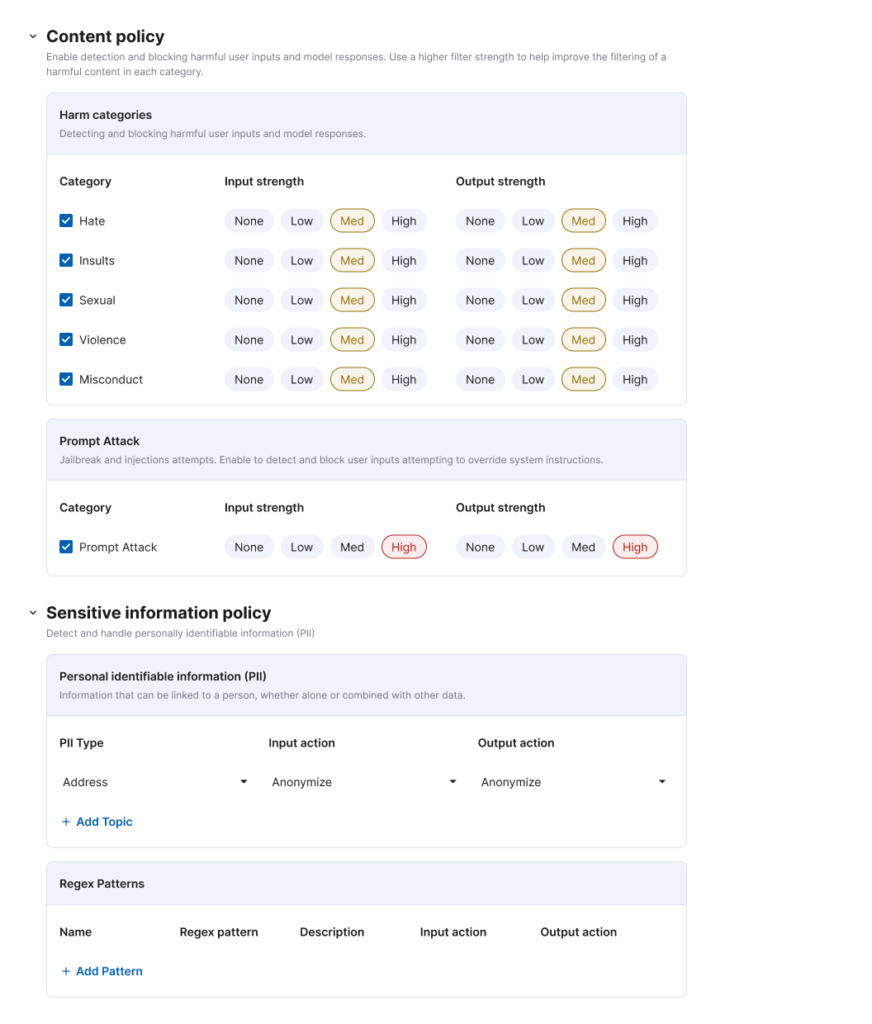
Governance
Governance is centralized within the GSX Agent Runtime, which provides a unified interface for managing the entire agent lifecycle from design to optimization. This framework ensures that all distributed agents remain coherent and governable, offering full audit trails and versioning capabilities to meet global compliance standards such as GDPR, HIPAA, etc.
MCP Support for AI Agents
No-Code MCP Onboarding
GSX provides a visual interface to connect to any external MCP server. Simply point the platform to an MCP host, and the server’s capabilities—including Tools, Resources, and Prompt Templates—instantly become available as drag-and-drop steps in your automation flows.
Secure Model Switching
Because MCP standardizes the communication layer, GSX allows you to swap your underlying LLM (e.g., switching from OpenAI to Anthropic) without breaking your integrations. The new “brain” communicates through the same MCP “connector” seamlessly.
Enhanced Governance & Audit
Every MCP-based action is automatically logged within the GSX observability suite. You gain full visibility into which tools were invoked, what data was accessed, and how the agent reasoned through its decisions—meeting the highest standards for enterprise transparency.