
TL;DR
Two new AI agent standards (ARD and OKF) have been introduced to help handle discovery and context, respectively. Generative Studio X (GSX) from OneReach.ai speaks ARD and OKF natively and adds governed execution, which is a genuine integration advantage.
In June 2026, two open specifications were proposed for the enterprise AI agent ecosystem: Agentic Resource Discovery (ARD) and Open Knowledge Format (OKF). Both are early. ARD is a v0.9 draft. OKF is v0.1. Neither is finalized. But both already carry enough multi-vendor backing that serious enterprise AI programs should take them seriously.
- ARD standardizes how AI agents find each other across platforms.
- OKF standardizes how agents read and share organizational knowledge.
Both represent meaningful progress for interoperability but neither are intended to govern execution or address fine-grained permissioning, cross-system orchestration, or auditability. Those are the layers that determine enterprise accountability, and exactly what the OneReach.ai GSX platform was built for.
Agentic Resource Discovery: For Finding AI Capabilities
Agentic Resource Discovery (ARD) is an open specification co-developed by eleven companies: Cisco, Databricks, GitHub, GoDaddy, Google, Hugging Face, Microsoft, Nvidia, Salesforce, ServiceNow, and Snowflake. It was published on June 17, 2026. ARD answers a foundational problem in multi-agent systems: agents cannot collaborate if they cannot find each other.
As AI systems scale from isolated deployments to enterprise-wide networks, agents benefit from a standard way to locate capabilities across teams, clouds, and vendor boundaries. ARD provides that layer. The specification is currently a v0.9 draft, and its contributors are inviting feedback through the project’s public repository before it stabilizes.
Table 1. What ARD Does
| Publishes capabilities | Organizations host ai-catalog.json at a well-known path on their domain, describing available agents, tools, MCP servers, APIs, and workflows. |
| Discovers across registries | Agents query federated registries using plain-language intent. Registries crawl published catalogs and return ranked matches with trust metadata. |
| Verifies identity | Publishers attach cryptographic trust metadata. Agents confirm a publisher’s identity before connecting, using the domain as the trust anchor. |
| Hands off to native protocol | ARD sits entirely before invocation. Once a resource is found and verified, the agent connects using that resource’s own protocol, such as MCP, A2A, or OpenAPI. |
What ARD Does Not Do
ARD is explicitly scoped to discovery. By design, it does not invoke resources, govern what agents are permitted to access, execute work across systems, or produce an audit record. The specification is a federated, multi-vendor protocol, not a product, and no single contributing company owns or authors it. What happens after the handoff is left to whatever platform receives the call.
Open Knowledge Format: For Packaging Agent Context
Open Knowledge Format is an open specification published by Google Cloud on June 12, 2026, currently at version 0.1. It addresses what Google calls the context-assembly problem: before an AI agent can do meaningful work, it must gather relevant knowledge from scattered, incompatible internal systems, including table schemas, metric definitions, runbooks, API documentation, and join paths between datasets.
OKF standardizes how that knowledge is packaged so any agent can consume it more easily. Google describes v0.1 explicitly as “a starting point, not a finished standard,” and expects the format to evolve as adoption grows.
Table 2. What OKF Does
| Defines a file format | OKF represents knowledge as a directory of markdown files with YAML frontmatter. Each file covers one concept. Files interlink using standard markdown links. |
| Makes knowledge portable | A bundle written by one producer can be consumed by any OKF-compatible agent without translation or custom SDK work. |
| Works anywhere | OKF bundles are plain files: a git repo, a tarball, or any filesystem. There is no required runtime, cloud dependency, or vendor lock-in. |
| Human and agent readable | Because OKF is just markdown, engineers and non-engineers alike can read, review, and update bundles in any text editor or GitHub interface. |
What OKF Does Not Do
OKF is not a service. It has no runtime, no synchronization mechanism, and no guarantee of accuracy. A bundle is as current as the last person or process that updated it. OKF has no mechanism to keep bundles current: that responsibility falls to whoever or whatever last edited the files. In production environments where data definitions and workflow logic change frequently, a manually maintained bundle can go stale, and stale context produces unreliable agent behavior.
What ARD and OKF Don’t Cover
ARD solves discovery. OKF solves context packaging. Neither was designed to solve what happens next, and what happens next is most of the work. Generative Studio X is built around five architectural pillars that exist precisely because finding a capability and reading its documentation is not the same as running it, reliably, inside an enterprise.
- Communication Fabric: An agent that discovers a capability through ARD still has to talk to it across whatever channel the interaction is happening on, voice, chat, email, and that conversation needs to hold together as one continuous session over time. ARD has no concept of a session. A capability discovered mid-conversation needs somewhere to land that preserves context across channels and time. That is what the Communication Fabric does.
- Contextual Memory System: An OKF bundle is a static file. The moment it’s read, that knowledge has to be combined with everything else already known about this user, this account, this conversation, much of it unstructured and scattered across systems that were never built to store or reason over it. OKF hands over one more knowledge source. It doesn’t do anything to integrate it with the rest. That integration is what the Contextual Memory System does.
- Cognitive Orchestration Engine: Once a capability is found and its context is read, something still has to decide which underlying AI service carries out the work, and that decision needs to stay flexible as services and vendors keep proliferating. This function is not something that ARD or OKF are designed to help with. They describe finding and reading, not deciding. The GSX Cognitive Orchestration Engine provides a model-agnostic decision layer.
- Agents: ARD discovers a resource. It does not discover an agent capable of holding a multi-step goal, peering with other agents, or operating across channels without a person watching every step. A capability found through ARD is a single callable thing. Turning a sequence of those into actual goal completion is a different problem, and it’s the one Agents on GSX are built to solve.
- Human-in-the-Loop: Not every discovered capability should be invoked automatically, and not every piece of context should be trusted without review. Neither ARD nor OKF has any mechanism for deciding when a human needs to be involved before something happens. That decision, and the infrastructure to act on it, lives in GSX’s Human-in-the-Loop model.
Figure 1: What ARD and OKF Cover and What They Don’t
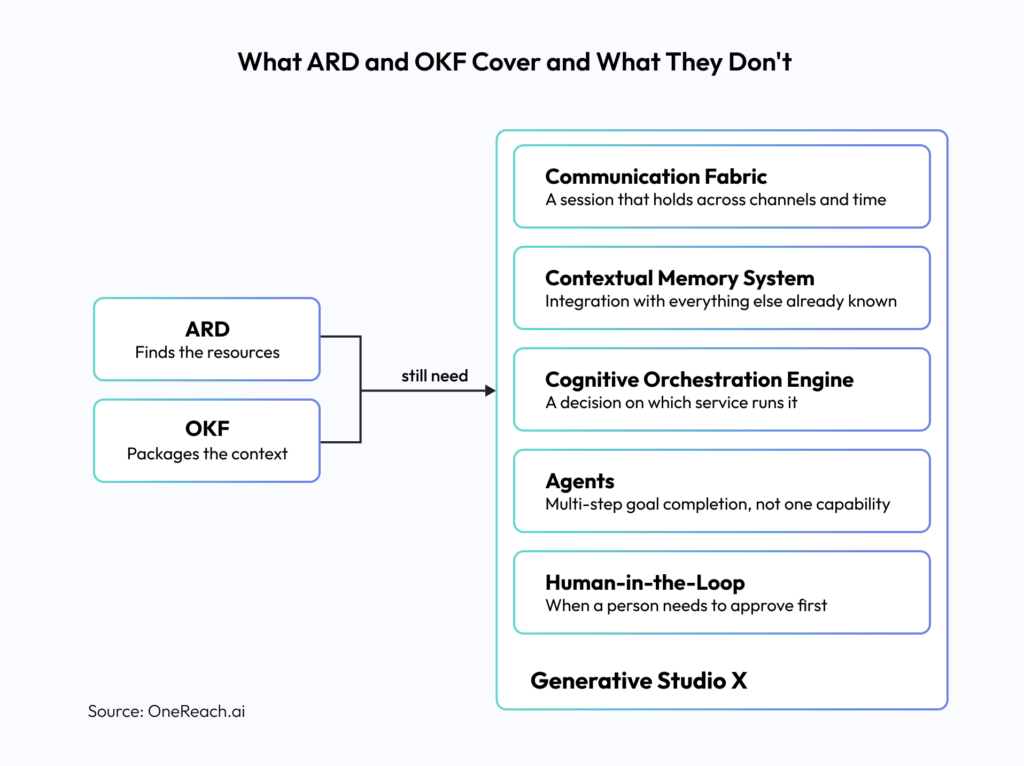
Together, these five pillars are what turn “found and documented” into “governed, coordinated, and running.” ARD and OKF make two narrow things easier. They don’t make the rest of the problem go away.
Why This Matters to You
Table 3. Relevance by Role
| CIO / CTO | Standards adoption raises real questions about openness and lock-in. The answer here: the interfaces are open, and the governed execution layer remains owned infrastructure you control. Adopting ARD and OKF does not mean ceding control over what your agents are permitted to do. |
| Compliance / Risk / Legal | Standards define format, not accountability. Permissions, audit trails, and isolation of regulated workloads live in the execution layer, where GSX operates, not in the specs themselves. |
| AI Architects / Engineering | ARD and OKF may solve discovery and context. The execution and governance layer is real, contested, and where other orchestration approaches already operate. GSX’s case there rests on native standards support plus governed execution, not on the layer being unclaimed. |
| Procurement / Finance | Layers that converge on discovery and context formatting will become commoditized. Durable differentiation and durable TCO impact sit in the execution and governance layer, where vendor dependency and risk are actually priced. |
Standards Define Interfaces. Running Them Takes More.
ARD tells agents where a capability lives. OKF tells agents what they need to know to use it. Both are early-stage specifications, still maturing. Neither tells an agent how to hold a session, integrate what it just read with everything else it knows, decide which service should act, complete a multi-step goal, or know when a human should be in the loop first. GSX speaks both standards natively and supplies the five things they don’t, competing directly in a layer that already matters to enterprise buyers today.
Other Resources:
- Introducing the Agentic Resource Discovery specification, Microsoft Command Line blog
- Agentic Resource Discovery Specification v0.9
FAQs
- What are the ARD and OKF standards for AI agents?
Agentic Resource Discovery (ARD) and Open Knowledge Format (OKF) are open specifications introduced in June 2026 for enterprise AI agents. ARD standardizes how agents find capabilities across platforms; OKF standardizes how agents read and share organizational knowledge. ARD is a v0.9 draft backed by eleven companies including Google, Microsoft, and Salesforce; OKF v0.1 was published by Google Cloud.
- What is Agentic Resource Discovery (ARD)?
ARD is an open specification that lets AI agents discover each other’s capabilities across teams, clouds, and vendors. Organizations publish an ai-catalog.json file at a known path on their domain; agents query federated registries, verify the publisher’s identity cryptographically, and then connect using the resource’s native protocol (MCP, A2A, or OpenAPI). ARD covers discovery only, not invocation, permissions, or auditing.
- What is the Open Knowledge Format (OKF)?
OKF is an open specification from Google Cloud that packages organizational knowledge (table schemas, metric definitions, runbooks, API docs) as a directory of markdown files with YAML frontmatter that any compatible agent can consume. OKF is a file format, not a service. It has no runtime and no mechanism to keep bundles current, so accuracy depends on whoever last edited the files.
- What don’t ARD and OKF cover?
Neither standard governs execution. ARD stops before invocation and OKF is a static file format, so both leave open permissioning, cross-system orchestration, session continuity, multi-step goal completion, human-in-the-loop controls, and audit trails. Those execution and governance layers determine enterprise accountability and are handled by orchestration platforms, not the specifications themselves.
- How does Generative Studio X (GSX) support ARD and OKF?
GSX from OneReach.ai speaks both standards natively and adds the governed execution layer they leave open. It auto-generates ARD catalogs with permission-governed discoverability, derives OKF bundles from its live orchestration graph so context never goes stale, and then governs, executes, and audits the calls — discovery, context, and execution in one path with a single record.