
Key Takeaways:
- AI agents depend on the context they receive, and incomplete or stale context leads to poor decisions and higher costs.
- Data access, larger context windows, and RAG solve part of the problem, but none provides a governed, shared record of organizational knowledge and decisions.
- Shared memory with provenance, ownership, permissions, and expiry lets agents build on prior work, turning context into an enterprise asset that grows in value with every agent.
We have all been on that call. You explain the problem to one person over the phone, get transferred, and explain it all over again. By the third person, you start wondering whether employees at the company you’re calling can even talk to each other.
Enterprises are building the same broken experience into their AI agents, and it’s happening across use cases. One agent knows the customer’s history. Another knows the latest policy. A third knows neither and answers confidently anyway.
The problem gets harder as agents sprawl across hundreds of applications, systems, knowledge bases, and business processes. If multiple agents are working with the same customer, what should they know, and should they all know the same thing?
The common workaround is to give agents more: stuff more documents in the prompt, fund bigger token budgets, and build another retrieval pipeline for every new agent. The bills go up, and the contextual challenge grows with them. Gartner makes an obvious prediction: by 2028, organizations that scale long-running or multi-agent systems without managed agent memory will face rising context costs, broken handoffs, and inconsistent agent behavior.
This is where shared memory becomes valuable. Enterprise AI agents need more than access to raw information. They need verified knowledge and the context behind it: what the organization knows, what it has decided, and what it has already done.
Context and Memory Do Different Jobs
Let’s separate two terms that often get blurred together. AI agent context is what an agent needs to know when it acts: the request, relevant records, applicable policies, and where the task currently stands. AI agent memory is bigger than that. Memory captures earlier conversations, decisions, outcomes, and procedures, so the next step, session, or agent doesn’t have to start from scratch.
Gartner identifies agent memory as “distinct from data storage, RAG, and context engineering. It governs how AI agents retain, retrieve, update, expire, and reuse context across sessions, workflows, and agents, with controls for memory scope, governance, and observability.”
Table 1. AI Agent Context vs. Memory
| Context | Memory | |
| Definiton | Information assembled for one decision | Information retained across decisions |
| Lifespan | One model call or task | Persistent, until updated, expired, or deleted |
| Contents | Current request, relevant records, policies, instructions, tools, and task state | Past conversations, decisions, outcomes, preferences, procedures, and learned information |
| Main risks | Context overload, outdated or irrelevant information, higher token costs | Stale or incorrect information, privacy and governance issues, uncontrolled accumulation |
Why Data Access Isn’t the Same as Context
Plugging an agent into a CRM or data lake gives it access to records. It doesn’t tell the agent which record is current, which definition of “customer” applies, or which policy takes precedence when two of them disagree. An experienced employee answers those questions almost without thinking. An agent needs those answers documented somewhere it can find them.
In Salesforce’s State of Data and Analytics research, 49% of data and analytics leaders say their companies occasionally or even frequently draw incorrect conclusions from data with poor business context. They also estimate that 19% of their data is siloed or unusable.
Agents inherit the same problem, but at a larger scale. At the Gartner Data & Analytics Summit in London in May 2026, Rita Sallam, Distinguished VP Analyst at Gartner, warned that agents without context, a clear understanding of the relationships and rules within an organization’s data, are far more likely to hallucinate, introduce bias, and produce unreliable results.
Robb Wilson, CEO and co-founder of OneReach, describes four phases AI agents move through as they get better at completing tasks in Age of Invisible Machines: literacy, knowledge, intelligence, and wisdom. The lines between them aren’t sharp. Effective skills use all four, and more advanced skills lean harder on the later ones.
- Literacy: The agent turns numbers and characters into information, such as decoding a stored integer into a formatted date.
- Knowledge: The agent understands what the information represents and recognizes that the date is the customer’s date of birth.
- Intelligence: The agent uses that knowledge to respond appropriately in different situations. It might recognize that a customer’s 18th birthday is a few days away.
- Wisdom: The agent draws on past customer interactions and stored data to make context-aware decisions, such as “You are about to turn 18. Your minor account will become a standard adult account. I’ll begin educating you on what that means as a member of our credit union.”
Data access gives an agent basic literacy. Context carries it through knowledge and intelligence. Wisdom takes memory: a record of past interactions, decisions, and outcomes the agent can draw on.
The Hidden Cost of Growing Context
When an agent gets something wrong, the natural reaction is to give it more to read. Larger context windows make that easy, and model providers now offer their own memory and session-retention features, so a conversation no longer disappears when the session ends. Someone still has to decide what belongs in the window, though, and the more you add, the harder it becomes for the useful facts to stand out from everything else.
Retained history also has to be paid for every time it’s used. Each exchange reingests everything that came before, plus whatever the last step added, so the same request costs more at step four than at step one. Reasoning models then spend additional tokens, billed at output rates, working through that growing context. Recall and reasoning compound with every loop. Gartner identifies context accumulation as the primary driver of that spend and places most of the agentic bill in redundancy rather than useful work.
In McKinsey’s State of AI 2026 survey, about one in five respondents say their organizations have already limited AI use because of operating costs, including token costs.
Provider memory has another limit: it lives inside that provider’s platform. It doesn’t follow the work to an agent running on a different model or built by a different team. Unless important information is retained in memory the whole organization can use, the next agent still starts from scratch.
Agentic FinOps: How to Measure, Manage, and Optimize AI Agent Costs
Learn MoreWhy RAG Doesn’t Solve the Contextual Problem
Retrieval-augmented generation (RAG) finds passages that look relevant to a question and puts them in front of the agent. That works well for a straightforward question like, “What does our travel policy say?” It’s less sufficient when the questions come up halfway through a task:
- What did another agent already promise this customer?
- Which of three conflicting documents is the current one?
- Is this agent even allowed to see what it just retrieved?
RAG is good at finding text that looks relevant, but it doesn’t inherently know when something was true, who owns the information, where the task stands, or who is allowed to see it. And because teams often build their own retrieval pipelines, every agent sits on its own small pool of memory, and none of those pools talk to each other.
Where Enterprise Memory Lives
The data, information, and knowledge that enterprise memory is built on are already there, but not the memory itself. They’re scattered across the organization:
- CRM, ERP, and billing systems hold transactions and account history.
- Documents and policy libraries hold rules and procedures.
- Ticketing systems hold exceptions and edge cases.
- People hold the know-how that hasn’t made it into a system.
- AI agents generate logs, decisions, and other useful information that often expires or gets buried before the next agent can use it.
IDC projects more than one billion AI agents worldwide by 2029. Every one of them will make decisions, handle tasks, and generate information that another agent could build on, if that knowledge is captured and made available.
Duplicate Agents Mean Duplicate Memory
Memory silos multiply with agent sprawl. When teams can’t see what others have already built, they build their own: a second customer service agent, another summarization agent, a refund agent for every region. Each duplicate brings its own prompts, its own retrieval pipeline, and its own memory pool, so the organization pays to store, retrieve, and reason over the same context several times.
The redundancy shows up in the work, too. One agent works out something another figured out an hour ago. Two agents quote different versions of the same policy to the same customer. When a request passes from agent to agent, each one loads its own copy of the customer file, and the token bill grows with every handoff.
Duplicate agents and duplicate memory share a fix. When teams can see which agents already exist and what they know, they can reuse an agent instead of building another, and every agent works from the same record.
What Shared AI Agent Memory Provides
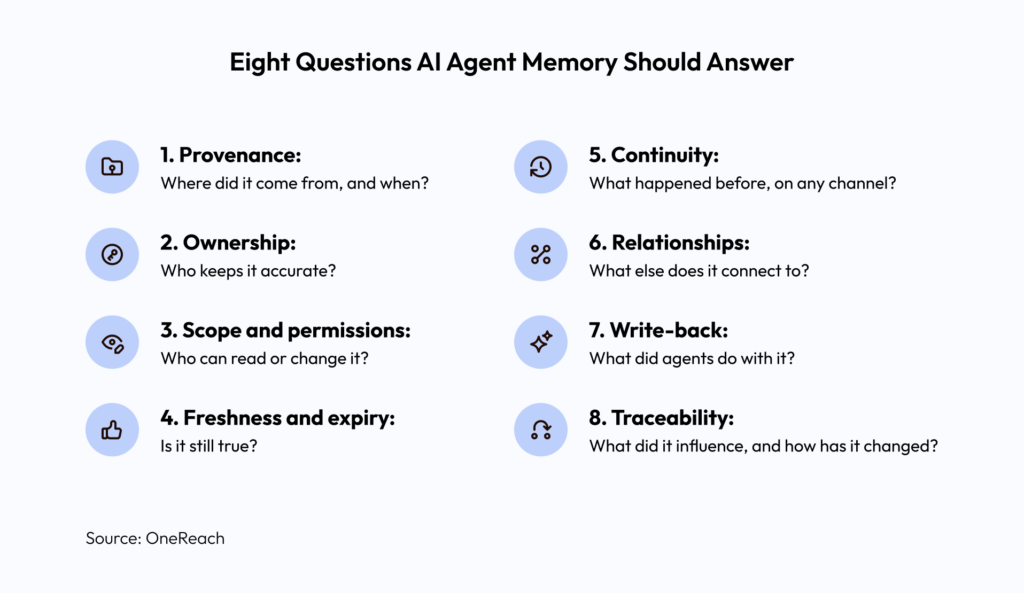
Shared memory stores information and makes it available to every agent authorized to use it. Two things make it worth relying on: a complete history and the right controls on every entry.
- Provenance: Each memory records its source and timestamp. If the billing agent promised a customer a credit during a call last Tuesday, the memory points back to that call, not to an undated note.
- Ownership: A named team is accountable for each memory and re-verifies it on a schedule. Finance owns the refund policy; the product team owns product specs.
- Scope and permissions: Access rules define which agents, users, and workflows can read or write each memory, and they carry over the roles and entitlements from the source systems. A support agent can see that a credit was issued without seeing the customer’s full payment history.
- Freshness and expiry: Each memory carries a time-to-live. A promotional price expires when the promotion ends, so no agent quotes it a month later.
- Continuity: Memory follows each customer across channels and sessions for weeks, months, or years. When a customer who disputed a charge in chat calls back three months later, the voice agent already knows how the dispute was resolved, and the customer doesn’t have to explain it again.
- Relationships: Memories link to the customers, products, tickets, and decisions they concern, so an agent can see that a complaint, a defect report, and a refund belong to the same case.
- Write-back: Agents record what they decided and did, and what happened next, so the following agent starts from the outcome instead of the original request.
- Traceability: Teams can see which memories influenced an action, how each memory changed over time, and roll back to an earlier version when an entry turns out to be wrong.
Provenance and ownership do most of the work. Without them, a memory store becomes another data lake, where a single stale or poisoned entry can mislead every agent that relies on it.
Figure 1: Eight Questions AI Agent Memory Should Answer
From Fragmented Data to Reusable Memory
The challenge for most enterprises is bringing the data their agents need together in a way they can use.
Start by consolidating the data agents need to access, agreeing on shared definitions so every agent interprets it the same way, and putting clear rules around what each agent can read and write. Then add a governed memory that captures important outcomes, decisions, and context as work happens.
That last step turns a single source of truth into reusable memory. When one agent records an outcome along with its source, owner, and relevant context, the next agent doesn’t have to start over. It can pick up where the previous one left off, with the information it needs already in place.
Context Becomes an Enterprise Asset
Context becomes an enterprise asset when it can outlive a single task or agent. Instead of being assembled, used, and discarded with every interaction, it can be captured, governed, and reused. The more agents can build on what came before, the more valuable that shared context becomes.
Gartner forecasts that by 2030, universal semantic layers will be treated as critical infrastructure. For enterprise AI, that points to a question: What will AI agents share?
OneReach Generative Studio X (GSX) includes a Contextual Memory System that connects to the data enterprises already have, maintains long-term context across channels and over time, and provides a governed source of knowledge that agents can access. It includes ownership and expiration controls to help keep information current, along with audit and traceability features that show where information came from and how it influenced an agent’s decisions.
The goal is to make the right context available to the right agent, at the right time, with enough history and governance to make it trustworthy.
8 Capabilities That Define an AI Agent Management Platform
Learn MoreFAQs
- What is AI agent memory?
AI agent memory is the capability that lets AI agents keep information from past work and use it again across tasks, sessions, and other agents. It usually combines short-term memory for the current task with long-term memory for past conversations, decisions, outcomes, and procedures.
- How is AI agent memory different from RAG?
RAG retrieves documents that look relevant to a question. Agent memory tracks what happened: what agents decided, promised, and did, when it was true, who owns it, and who may see it. Most enterprises need both: RAG for grounding answers in documents, and shared memory for continuity across tasks and agents.
- Why do multi-agent systems need shared memory?
Without shared memory, each agent rebuilds context on its own. That leads to duplicated work, broken handoffs, and conflicting answers. With a shared, governed memory, one agent records an outcome with its source and owner, and the next agent picks up where the previous one left off.