
For the past two years, the dominant AI conversation inside enterprise technology teams was about speed: which use cases to prioritize, how quickly to move from pilot to production, how many agents to ship before the competition did. That conversation has changed in 2026. Agentic AI governance has become the question boards and executive teams are grappling with.
How do you govern your AI? McKinsey’s 2026 AI Trust Maturity Survey found that the answer is often unclear. Governance and agentic AI controls lagged every other measured dimension across all regions and industries studied, with fewer than a third of the roughly 500 organizations surveyed reaching meaningful governance maturity.
So what does it mean to govern AI at enterprise scale, and what AI governance framework can enterprises use?
What Is Enterprise AI Governance?
AI governance is a collection of capabilities and controls that covers registration and authorization of AI agents, operating boundaries, accountability frameworks, and auditability built into the architecture from the start, rather than retrofitted once agents are already live. Gartner suggests that enterprise AI governance is the set of conditions that determine whether AI agents are assets or liabilities to the enterprise.
Figure 1: Enterprise AI Governance
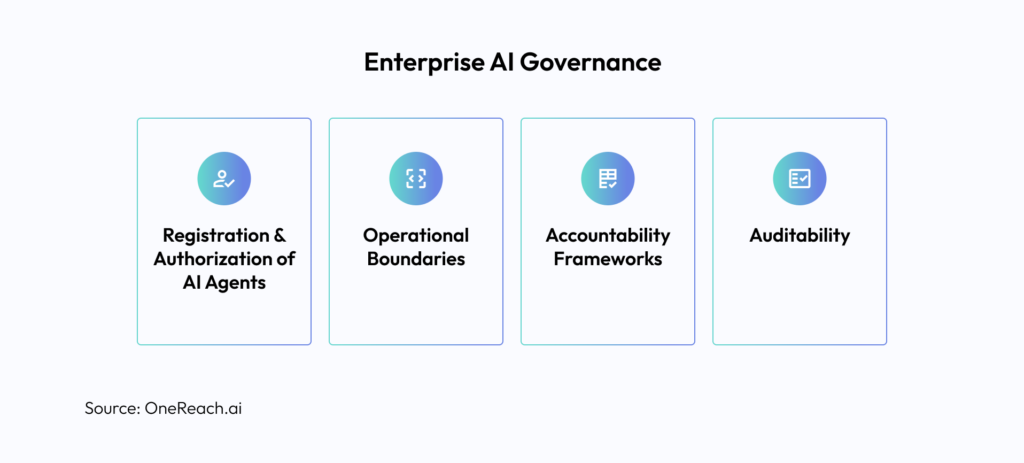
Policy documents and ethics guidelines describe what an organization intends. Governance is what makes intent operational. When agents read documents, call APIs, update records, and sequence decisions across systems, the controls that matter are those embedded in how agents are deployed: how their access is granted, how their actions are logged, how anomalies are detected and escalated. A governance framework that lives in a document but lacks technical enforcement tends to describe what has already happened rather than shape what will.
Here is a useful test: can you identify, right now, every agent running in your enterprise? What data each one accesses, what it is authorized to decide independently, and who owns the outcome if something goes wrong? For most organizations, answering those questions takes longer than it should. That lag is the governance gap.
Why Does Enterprise AI Governance Matter?
Gartner’s 2026 CIO and Technology Executive Survey found that 17% of enterprises have already deployed AI agents, with another 42% planning deployment within the next 12 months. By 2028, Gartner projects 33% of enterprise software applications will include agentic capabilities, up from under 1% in 2024. That pace of adoption produces a familiar enterprise pattern. Departments build and deploy AI agents faster than central teams can track them, and solutions that start with a few agents become dozens of autonomous systems with overlapping permissions, inconsistent logging, and no consolidated picture of what any of them are doing or why.
The regulatory timeline is compressing that window. Compliance regulators are no longer asking whether enterprises have an AI policy, they are asking whether enterprises can demonstrate, with evidence and in real time, that their AI systems are operating within defined parameters.
What Happens When Governance Lags Deployment?
When agents are deployed faster than they are registered and tracked, the first casualty is visibility. And lack of visibility means that risks are assumed to be present but unknown.
This creates two scenarios. In the first, agents are unknown entirely, they are built and deployed outside central oversight. In that case, organizations operate blind. An agent scoped for sales lead qualification may access CRM data it was never meant to touch, while a customer service agent continues routing users through outdated processes. These issues rarely surface immediately; they accumulate until they appear as compliance findings, customer complaints, or audit gaps.
In the second scenario, agents are known but ungoverned. They are registered but not properly constrained, leading to overlapping permissions, inconsistent logging, and fragmented decision-making across teams. Point solutions multiply, siloes deepen, and technical debt grows as autonomous systems drift further from intended business logic.
At scale, these conditions compound. Gartner research notes that multi-agent systems tend to fail through dysfunctional interactions between components rather than isolated failures. A single misclassification can cascade across workflows before detection. The result is not just technical failure but financial and operational exposure. Gartner projects that by 2029, claims related to automated decision-making will have doubled compared to the previous decade, driven largely by deployments lacking adequate guardrails.
The implications are reduced profitability through duplication and inefficiency, slower growth due to operational friction, increased likelihood of reputational damage and customer trust erosion, and heightened risk of compliance sanctions.
Transparency as an Architectural Requirement in Agentic AI
Learn MoreAI Governance in Practice
AI governance should include a structured set of policies, technical controls, and accountability mechanisms that govern how AI agents are authorized, monitored, and managed across their full lifecycle. In practice, effective AI governance needs to address five areas:
- Accountability and operating boundaries. Each agent needs a defined scope: what it can access, what it is authorized to decide autonomously, and what requires human review before execution. How does this work in practice? Each agent holds a specific role, a planning agent coordinates the workflow, and human review is required before final outputs are acted on. That structural design is what made the system auditable and deployable at scale.
- Identity and access management. AI agents need unique, verifiable digital identities for the same reason employees do. Identity enables access control, generates audit trails, and makes it possible to revoke access cleanly when an agent is modified or retired.
- Transparency. Without visibility into what an agent did, when, and why, accountability remains theoretical. Transparency is the governance condition that makes agentic AI trustworthy to the people and institutions that depend on it. It operates across three layers: the infrastructure layer (operational telemetry), which covers system health, performance, and real-time detection of failures; the human collaboration layer (transparency of agent actions), which enables people to understand what agents are doing and why in the context of their workflows; and the accountability layer (auditability), which allows organizations to reconstruct decisions, inputs, and outcomes after the fact for investigation, compliance, and improvement.
- Continuous evaluation. Agentic systems produce non-deterministic outputs: the same input can generate different decisions in different contexts. A one-time deployment review captures a snapshot, nothing more. Governance requires evaluation to run continuously against defined success criteria, built into the operating architecture rather than handled as a scheduled audit.
- Interoperability and coordination controls. A governance layer needs to cover the full agent portfolio across vendors, models, and deployment environments — positioned above individual applications and cloud tiers rather than embedded inside any one of them.
AI Governance As a Must-Have Condition
Enterprises who take AI governance seriously will gain a substantial competitive advantage in the next year versus those who fail to make the investment.
AI Architecture Guide for 2026: Mastering the Agentic Enterprise
Download the GuideFAQs
1. What is the difference between AI security and AI governance?
AI security protects systems from external threats, including unauthorized access, adversarial attacks, and data exposure. AI governance controls how agents are authorized to act, what they can decide autonomously, and who is accountable when something goes wrong. Security is one component of governance, not a substitute for it.
2. Why does an enterprise need a core architecture for agentic AI governance?
Application-level governance only covers the application it lives in. When agents operate across departments, clouds, and vendor stacks, each deployment creates its own visibility boundary, and no single team sees the full picture. A core architecture sits above that complexity, applying consistent policy across every agent regardless of where it was built. Without that layer, governance becomes a patchwork that grows harder to manage with every new deployment.
3. How can AI governance help manage AI agent sprawl and systemic risk?
Governance addresses sprawl through registration and inventory when every agent has a defined scope and an accountable owner before it reaches production. Systemic risk, which typically emerges from agents interacting in unexpected ways, is managed through observability tools that monitor behavior across the full portfolio, not just individual deployments.