Key Takeaways:
- Guardian agents provide a scalable, real-time governance layer for monitoring and intervening in agent activity, but they only work effectively when deployed within a tiered control architecture.
- How much guardian agent infrastructure you need is partly a function of how well your underlying agentic system is designed in the first place.
- The true determinant of safety, cost, and operational efficiency is upstream system design: a governance-first agentic architecture reduces the need for heavy oversight and prevents the escalation of avoidable risks.
Your AI agents might be your biggest AI risk. Not necessarily because someone is trying to hack them with a prompt injection or something. But because your teams made them, and they are going to do exactly what they were designed to do, even when that turns out to be the wrong thing.
Gartner projects that through 2028, at least 80% of unauthorized AI agent transactions will result from internal policy violations, information oversharing, and misguided agent behavior and not from malicious outside attacks. That is a jarring statistic for organizations that have been thinking about AI risk primarily through a cybersecurity lens.
There is a real risk that your own agent, operating at speed, misreads an edge case in your procurement policy, overshares sensitive data with a connected system, or takes an action that can’t be undone. And the kicker? It happens while your team watches a dashboard that does not show it happening at all.
Guardian agents are one important tool for addressing this. They are not the whole answer. No single product or technology is. But understanding what guardian agents are, how they work, and where they fit in a broader governance strategy is essential for any organization deploying AI agents at scale.
What Is a Guardian Agent?
A guardian agent is an AI-based system that monitors, evaluates, and in some cases intervenes in the actions of other AI agents. They act in real time, at scale, without requiring a human to be present for every decision.
Gartner defines them as “a blend of AI governance and AI runtime controls in the AI TRiSM framework that supports automated, trustworthy and secure AI agent activities and outcomes.” In plain terms: a guardian agent watches other agents work, checks what they are doing against defined rules and policies, and acts when something looks wrong.
The key thing to understand is that a guardian agent is not a dashboard, a policy document, or a compliance checklist but an AI agent in its own right. These are agents that police other agents. They observe and check their behavior, report it, and then can also act on what they observe.
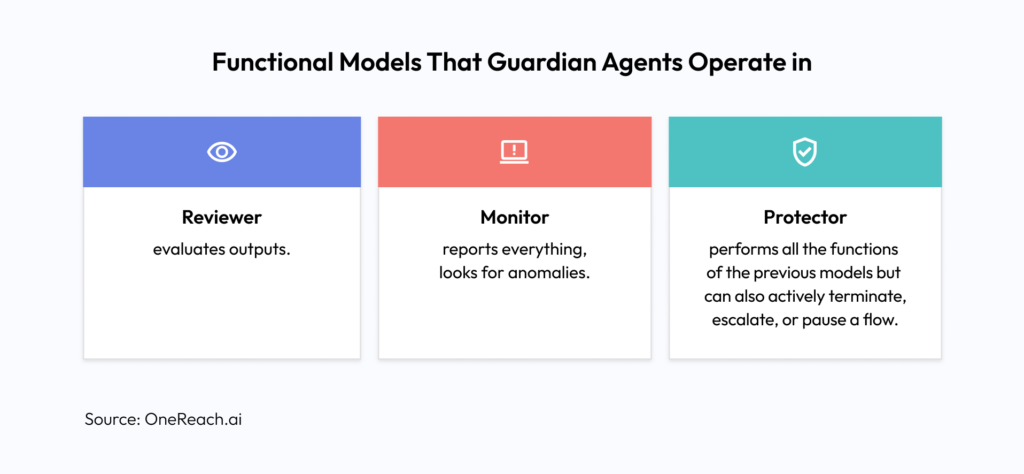
Gartner has described three functional modes that guardian agents operate in which helps to understand the variety of roles for these agents:
- Reviewer: Evaluates the content and outputs of AI agents for accuracy and acceptable use. Think of this as quality control on what an agent produces before it reaches the end user or downstream system.
- Monitor: Observes agent behavior over time, tracks patterns, and flags anomalies for human or automated follow-up during and throughout any given process flow. The monitor does not necessarily stop anything. However, it makes sure the right people or systems see what is happening.
- Protector: The role of this type of guardian agent is to actively adjust, block, or remediate agent actions during operations using automated enforcement. This is the most autonomous mode and the one most organizations are still working toward. It requires high confidence in the rules and enough context for the guardian to act without creating more problems than it solves.
Figure 1: Functional Models That Guardian Agents Operate in
Most organizations start with reviewing and monitoring capabilities and evolve toward active protection as their governance maturity grows. Where you start depends on the specific use case, your organization’s risk tolerance, the stakes of your agent’s actions, and how well your underlying architecture supports you.
What Is Enterprise AI Governance?
Learn MoreThree Ways to Keep Humans in the Loop (And When Each One Makes Sense)
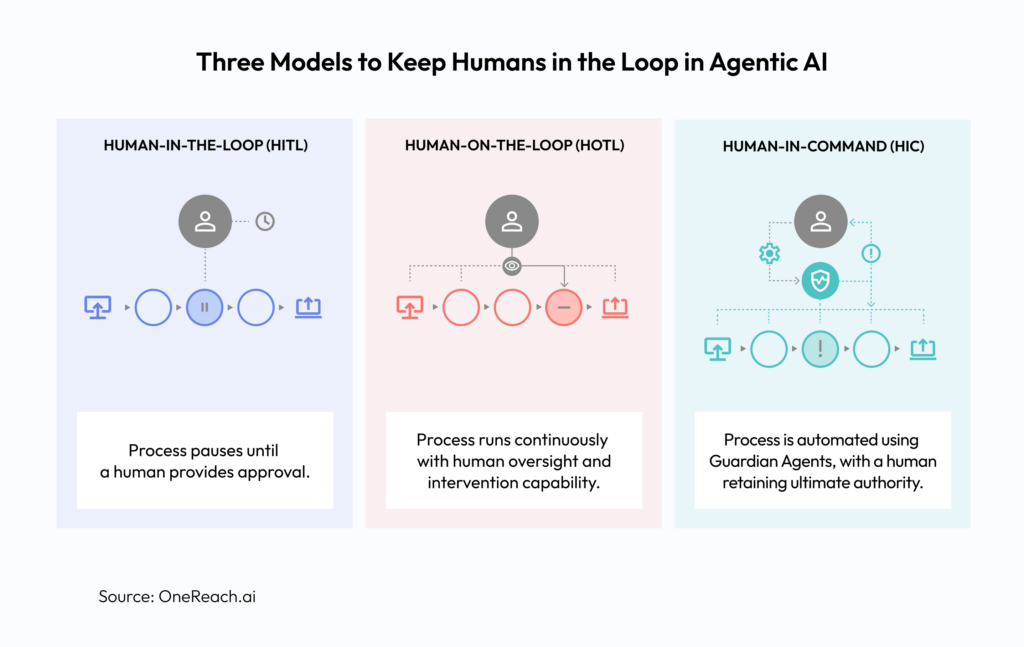
Before guardian agents became a concept, in simple terms, organizations had two main options for maintaining oversight of automated processes: stop and ask a human, or let a human watch and intervene. Guardian agents represent a third option that becomes more enticing as scale and speed make the first two untenable.
Here is how the three models compare:
- Human-in-the-Loop (HITL): The workflow proceeds step by step until it hits a defined checkpoint. There, it stops completely. No downstream action can occur until a human reviews the situation and makes a decision. The human is the gate. This model offers maximum oversight and inherent accountability, but it trades speed and scale for that certainty. At lower volume or high stakes, HITL is often the right call. However, it is not the most efficient solution.
- Human-on-the-Loop (HOTL): The workflow doesn’t pause like it does with HITL. It continues, and a human observer monitors it in real time like an inspector walking an assembly line who can pull the stop cord if something goes wrong. The intervention capability is real, but it isn’t automatic. The human has to see the problem, assess it, and act before the process moves on. The practical failure mode is predictable: as agent volume grows and processes multiply, one inspector becomes responsible for watching dozens of lines simultaneously. The coverage is at a high risk of degradation or, at the very least, an expected margin of error. This approach requires extremely adequate solution design or use cases with lower stakes.
- Human-in-Command (HIC): It is a relatively new but growing concept in enterprise AI governance and it describes an organization where humans retain ultimate authority and accountability over AI systems. Guardian agents are one of the key enabling technologies for Human-in-Command at scale. In essence, it is the empowered version of HOTL that controls the risk of only overseeing a process rather than providing approval like in the case of HITL.
Figure 2: Three Models to Keep Humans in the Loop in Agentic AI
How Guardian Agents Work And What They Cost
Guardian agents do not evaluate every event the same way. A well-designed guardian agent uses a tiered evaluation approach that matches the cost and depth of analysis to the actual ambiguity and risk of each event.
Here is how the funnel works, from top to bottom:
- Tier 1: Deterministic Rules
Fast, cheap, and reliable for high-volume, low-ambiguity events. Preestablished policy checks: is this vendor on the approved list? Does this amount fall within authorization parameters? Does this data type match what this agent is permitted to access? Has payment already been made? Do the payment amounts reconcile with existing records? The majority of events resolve here without involving AI reasoning at all.
- Tier 2: Statistical and Contextual Evaluation
For events that pass basic rule checks but show behavioral anomalies, unusual timing, atypical amounts relative to historical patterns, combinations of actions that individually look fine but together look suspicious. This is pattern-matching against a behavioral baseline, not LLM reasoning. - Tier 3: Fine-Tuned SLM (Small Language Model) Cognitive Evaluation
Medium-ambiguity cases that require more contextual judgment than statistical analysis can provide, but do not require the full reasoning capability of a large model. Faster and cheaper than Tier 4, designed to handle the cases where nuance matters but genuine complexity is limited. - Tier 4: LLM (Large Language Model) Cognitive Evaluation
Reserved for genuinely ambiguous, high-stakes decisions. Full reasoning, highest cost, lowest volume. Examples: a request that could be legitimate training content or a social engineering attempt, a transaction pattern that statistically looks wrong but has a plausible legitimate explanation, an agent action sequence that has no clear policy precedent.
What About Token Costs?
The cost concern here is legitimate and worth taking seriously. If a guardian agent is escalating everything to Tier 4,it can significantly increase compute costs, introduce noticeable latency into your processes, and potentially create a new bottleneck that rivals the one you were trying to eliminate. The design of the evaluation hierarchy is central to whether the guardian agent delivers actual value.
Organizations that deploy guardian agents without this tiered architecture often find that they have made their systems slower, more expensive, and only marginally safer. The funnel architecture is what makes guardian agents operationally viable at enterprise scale.
The AI Token Trap: Why the Real Cost of AI Isn’t What You Think
Read MoreThe Three AI Blind Spots That Make Guardian Agents Necessary
Even well-governed organizations have significant gaps in AI visibility. Gartner identifies three categories of AI activity that traditional security and governance tools systematically miss and that guardian agents are specifically designed to address:
- Embedded AI: AI features built into SaaS tools, software platforms, and infrastructure often without IT or security teams knowing they are there. A CRM that now uses AI to auto-draft customer responses. An HR platform that uses AI to screen documents. A finance tool that uses AI to flag anomalies. These features are active agents, in a functional sense, and they have access to sensitive data. Many organizations have no visibility into what they are doing.
Example: A SaaS customer support platform automatically enables an AI summarization feature in an update. The AI now processes every support ticket, including those containing PHI or PII. IT never saw the feature release. Compliance never assessed the data flow. The guardian agent is the only layer positioned to detect and flag this activity.
- Shadow AI: Employees using unauthorized AI tools, including personal subscriptions to general-purpose AI assistants, browser-based AI extensions, unofficial productivity apps, to do their jobs. This is not malicious. It is usually well-intentioned. And it creates data leakage, compliance exposure, and wasted investment in sanctioned solutions.
Example: A sales team starts using a third-party AI tool to summarize call recordings and generate follow-up emails. The recordings include pricing strategy, deal terms, and customer data. The tool’s data retention policy is unknown. The company’s official AI stack is completely bypassed.
- AI Browsing Agents / Computer Use Agents: Autonomous agents that interact with the web, execute tasks on remote servers, or control interfaces, operating entirely outside the reach of traditional endpoint security and perimeter tools. These agents can browse, fill forms, initiate transactions, and take actions that look like human activity from the outside.
Example: A research agent is deployed to gather competitive intelligence. It is given broad browsing permissions and begins interacting with third-party platforms, creating accounts, and submitting forms to access gated content. All beyond the enterprise’s security perimeter and outside any audit trail.
Each of these categories represents AI activity your organization is probably already responsible for, whether or not you know it is happening. The practical implication here is simple: you cannot govern what you cannot see, and guardian agents provide the discovery and visibility layer that makes governance possible.
Architecture First: The Best Guardian Agent Is One You Need Less Often
There is an important idea buried in all the guardian agent conversation that does not get enough attention: how much guardian agent infrastructure you need is partly a function of how well your underlying agentic system was designed in the first place.
An ounce of prevention is worth a pound of cure is especially true here.
Agentic systems built without governance as a core design consideration tend to look like this: agents with broad permissions because narrower ones felt limited at deployment time, no consistent identity management across agent types, limited native audit instrumentation, unclear behavioral boundaries between agents, and policy enforcement that was meant to be added later. When organizations try to govern these systems after the fact, they need heavier guardian agent overhead to compensate for what the architecture should have handled.
The inverse is also true. An enterprise agentic platform designed with governance built in, including defined agent roles, bounded and least-privilege permissions, native audit trails, deterministic policy enforcement at the orchestration layer, consistent agent identity management greatly reduces the guardian agent surface substantially. Agents do less of what they should not do in the first place. Edge cases are fewer. Escalations are more meaningful because the noise is lower.
This does not mean guardian agents become unnecessary. For high-stakes, policy-driven processes operating at large scale, they remain an important control. But the total governance burden, and quite frankly, the total governance cost, is significantly lower when the foundational architecture is sound.
For organizations evaluating platforms today, this is worth treating as a first-order question: does this platform build governance in, or does it require you to layer it on? Platforms that inherit baseline controls through underlying infrastructure and build additional policy enforcement into the orchestration layer natively give your guardian agents a much smaller and better-defined surface to work with.
Learn how OneReach.ai’s GSX platform can support your needs
Connect with UsGoverning the Governors: Is This Going to Be A Problem?
Here is the part most guardian agent articles skip.
When you deploy guardian agents built on generative AI, you introduce a new system that itself needs to be governed. Guardian agents can also be manipulated; prompt injection attacks at the supervision layer are a real and documented threat. They can be wrong in high-stakes situations. They can be over-permissioned. They can create the appearance of oversight without its substance.
Gartner identifies five critical controls for the guardian agents themselves:
- Contextual access control: Guardian agents should be treated as unique service identities within identity and access management systems, with granular, context-aware permissions that adjust based on data sensitivity and operational context.
- Input and output filtering: Protects against prompt injection attacks targeting the guardian agent itself, and ensures the guardian’s outputs comply with content and compliance policies.
- Task execution control and sandboxing: Guardian agent operations should be bounded by whitelisted APIs, rate limits, dry-run simulations, and rollback capabilities, so a malfunctioning guardian cannot disrupt the systems it is meant to protect.
- Continuous observability: Real-time monitoring of the guardian agents themselves, with intervention capabilities and alerts for anomalies in their own behavior.
- Immutable audit logging: Timestamped, tamper-evident logs of all guardian agent actions and decisions, for accountability and compliance purposes.
For many organizations, this recursive governance requirement will be genuinely challenging to implement well. Adding a governance layer, then adding a governance layer on top of that governance layer, creates compounding complexity and cost that can outpace the operational benefits it is meant to protect.
There is also an accountability question that the industry has not resolved: when something goes wrong despite the controls (and eventually it will), who is responsible? If the operational agent failed, is that the platform vendor? If the guardian agent missed it, is that the oversight vendor? If the architecture permitted the edge case in the first place, is that an internal engineering decision? Regulatory and legal frameworks have not caught up with the distributed accountability structure that layered agentic systems create. Organizations deploying these systems today are operating ahead of the liability clarity that will eventually govern them. That is worth knowing going in.
None of this is an argument against deploying guardian agents. It is an argument for going in with clear eyes about the full scope of what you are taking on.
The Right Question to Ask Before Buying Anything
LLM-based agents need controls. That is not in question. The question is which controls, built into what architecture, deployed in what sequence.
Guardian agents are a soon-to-be legitimate part of the enterprise AI risk stack. For high-stakes, policy-driven, high-volume processes, they provide a level of real-time oversight that no other mechanism can match at scale. But they are not a slam dunk for every situation. Deployed without careful design, they add cost and latency. They can create governance theater, that is the appearance of oversight without reality of making a real risk mitigation impact. And as the metagovernance challenge shows, they can introduce new accountability questions rather than resolving the ones that already exist.
The organizations that navigate this most successfully start with the right foundational architecture. Governance needs to be baked into each and every agentic solution, not added on like icing after the fact.
The right technology partner helps you design the agentic architecture so that governance is inherent to how the system operates. Yes, this may be with guardian agents filling the gaps where additional oversight is genuinely needed. But it should absolutely not be to compensate for what the architecture should have handled in the first place.
That foundational conversation is harder to have than buying a product. It is also the one that determines whether your agentic AI deployment is something you can operate, govern, and be accountable for. Or is it something that operates you?
Transparency as an Architectural Requirement in Agentic AI
Learn MoreFAQs
1. What is a guardian agent in AI systems?
A guardian agent is an AI system that monitors, evaluates, and sometimes intervenes in the actions of other AI agents. It operates in real time to ensure compliance with policies, detect anomalies, and prevent unsafe or unintended behavior.
2. How do guardian agents decide when to escalate a decision?
Guardian agents typically use a tiered evaluation model. Most events are handled by deterministic rules or statistical checks. More complex cases escalate to fine-tuned small language models for contextual judgment, and only the most ambiguous or high-risk cases are sent to large language models for full reasoning. This structure helps balance cost, speed, and accuracy.
3. Why are guardian agents important for enterprise AI governance?
Guardian agents are important because many AI risks come from internal agent behavior rather than external attacks. They help address issues like policy violations, data oversharing, and shadow or embedded AI usage. By providing real-time oversight across distributed systems, they enable scalable governance in environments where human-only monitoring is no longer sufficient.