Deploying agents is easy. Governing them, coordinating them, and making them work as one system is not. The gap between deploying AI and extracting value from it does not live in the model. It lives in the infrastructure.
According to McKinsey, 88% of organizations use AI in at least one function, yet only 6% report meaningful enterprise-wide impact. The differentiator is not which agents were deployed. It is whether the operational infrastructure exists to coordinate them. Workflow redesign and governed orchestration, not agent deployment alone, separate high performers from the rest.
For COOs, operations leaders, and CX leaders, this gap has a direct financial consequence. Every onboarding queue that stalls a new customer, every SLA breach that goes unresolved, every handoff lost between agents represents value that was promised and not delivered. Agent sprawl (AI capabilities running without a shared governance layer) is the condition that produces these failures at scale. The goal is not more agents. It is the infrastructure that makes agents work together reliably.
What AI Orchestration Means for Revenue
Agentic orchestration is the set of platform capabilities and runtime functions that govern how AI agents, deterministic systems, and humans coordinate as one architecture, with shared policies, telemetry, and accountability, so that dispersed intelligence produces predictable, auditable, outcome-driven execution rather than isolated task-level efficiency.
Three concepts in this definition carry the most revenue-critical weight: govern, auditable, and outcome-driven. Each one represents a condition that agent deployment alone cannot provide. Together, they define what infrastructure must deliver for AI to move from experiment to operational asset.
IDC FutureScape 2026 forecasts that by 2030, 45% of organizations will orchestrate AI agents at scale across business functions. The question is not whether orchestration becomes the standard. It is whether your organization builds that infrastructure before the operational cost of not having it becomes visible.
Figure 1: Foundational Components of the Agentic Orchestration
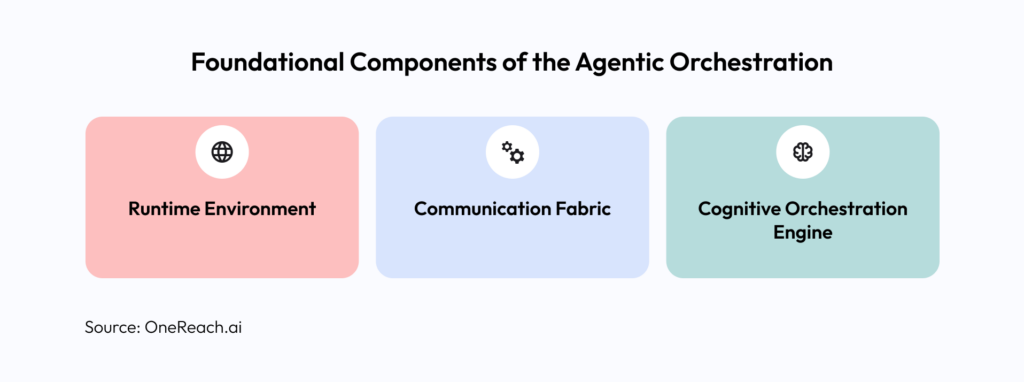
At the architecture level, governed agentic orchestration requires three foundational components working as one system:
- A runtime environment that governs how AI agents are deployed, monitored, and scaled in production. It enforces reliability, observability, and policy at scale.
- A communication fabric that provides unified session management across every channel and system. It ensures continuity across every interaction, regardless of where that interaction starts or ends.
- A cognitive orchestration engine that coordinates multi-agent workflows, manages task routing and handoffs, and ensures agents operate as a cohesive system aligned to business outcomes rather than isolated tasks.
Together, these components replace scattered point solutions with a single governed architecture. Agent sprawl becomes impossible to sustain at scale when every agent operates within shared policies, shared telemetry, and shared accountability.
Why AI Runtime Should Be Your Top Priority
Learn MoreHigh-Stakes Business Scenarios When TTR Pressure Spikes
Time-to-revenue risk spikes during organizational change: when processes break down, headcount shifts, and customer-facing systems are in flux. These are the conditions when agent sprawl is most expensive: siloed AI capabilities running without a governance layer, producing unpredictable outcomes when consistency is most needed.
These are the three common scenarios where TTR exposure peaks most acutely and where agentic orchestration delivers its most measurable return.
Corporate Restructuring
Widespread corporate restructuring continues to reshape enterprise operations. Gartner projects that through 2026, 20% of organizations will use AI to flatten their structures. The downstream effect is predictable: account ownership shifts, escalation paths break, and CRM data goes stale. SLA breaches occur not because the product failed, but because the human coordination layer has been restructured away.
Where agentic orchestration helps:
- Process logic, escalation policies, and SLA rules live in the architecture, not in the people who were reorganized out of it. Governance does not degrade when headcount does.
- AI agents maintain context continuity across channels and sessions, so customers experience no disruption when account ownership changes.
- Human-in-the-loop (HitL) controls ensure that high-stakes decisions, such as contract modifications and exception handling, still route to humans even as routine workflows run autonomously.
- Resolve revenue recognition delays caused by unsigned paperwork, unprovisioned accounts, or missed handoffs, which are eliminated through auditable, agent-managed workflow completion with a complete audit trail.
Post-Merger and Acquisition Integration
M&A integration is one of the most TTR-intensive scenarios an operations team faces. Two customer bases, two CRMs, two support playbooks, and two SLA sets must converge while revenue from both sides keeps flowing.
Where agentic orchestration helps:
- Multi-agent systems (MAS) can run parallel data reconciliation workflows across legacy systems, flagging duplicates and surfacing policy conflicts with full auditability at every step.
- A unified orchestration layer establishes consistent service governance, so customers from both organizations receive the same SLA coverage and resolution quality.
- Onboarding agents re-provision migrated accounts in governed, auditable batches rather than queuing them for untracked manual processing.
- Revenue attribution and contract compliance are verified automatically as part of the integration workflow, rather than as a separate, delayed finance reconciliation.
Rapid Market Expansion or New Product Launch
When a company enters a new market or launches a new product, onboarding volume spikes before support infrastructure has scaled to match. Early customers wait longer to reach first value, increasing churn risk at exactly the moment NPS matters most.
Where agentic orchestration helps:
- Coordinated AI agents handle standard onboarding tasks (configuration, credentialing, initial training delivery) and scale to the required volume.
- A shared orchestration layer ensures consistent service logic across new geographies or segments, so new customers receive the same governed experience as the established base.
- Proactive milestone check-ins from AI agents reduce time-to-first-value without adding customer success headcount.
Across all three scenarios, the pattern is the same. TTR declines when the operational infrastructure loses management capacity. Governed agentic orchestration keeps workflows stable and accountable as organizational conditions change.
AI Orchestration as an Enterprise Strategic Priority
Enterprises do not struggle to deploy AI agents. They struggle to make them work together. Without orchestration, agents operate as isolated units, each introducing its own logic, dependencies, and failure modes. Productivity degrades. Accountability disappears. Time to revenue extends, not because work is not happening, but because it is not coordinated.
Orchestration resolves this by governing how work is executed, how decisions are made, and how outcomes are verified. Every agent operates within a defined system of policies, context, and shared objectives. Work moves forward without losing continuity. Exceptions are contained. Outcomes are auditable. This is the condition under which AI becomes reliable.
Design, govern, and orchestrate AI with OneReach.ai
Book a DemoFAQs About AI Orchestration
1. What is AI orchestration, and how does it reduce time to revenue?
AI orchestration refers to the platform capabilities and runtime functions that govern how AI agents, deterministic systems, and humans work together as one coordinated architecture. By enforcing shared policies, telemetry, and accountability, orchestration ensures that dispersed intelligence produces predictable, auditable, and outcome-driven results, reducing delays, missed handoffs, and stalled customer interactions that slow time to revenue.
2. Why do AI agents fail to deliver enterprise-wide impact without orchestration?
Without a governance layer, AI agents operate in isolation, producing inconsistent outcomes, stalled workflows, and untracked handoffs. Orchestration ensures all agents work together reliably, maintaining process continuity even during restructuring, M&A, or rapid market expansion.
3. Which business scenarios benefit most from agentic orchestration?
Time-to-revenue risk peaks during high-change scenarios, including corporate restructuring, post-merger integration, and new market or product launches. Agentic orchestration provides continuity, governance, and auditability in these scenarios, coordinating multi-agent workflows, maintaining SLA compliance, and ensuring that revenue-critical processes proceed without delays or errors.