Many organizations claim they’re omnichannel, but the reality is fragmented experiences at nearly every turn for both customers and employees. Customers bounce between chat, voice, and email, repeating the same story, while internal teams juggle disconnected tools and conflicting queues, pogo-sticking between applications to keep things moving. Voice, chat, email, self-service, back-office workflows — each runs its own logic and data, glued together with brittle integrations and manual workarounds.
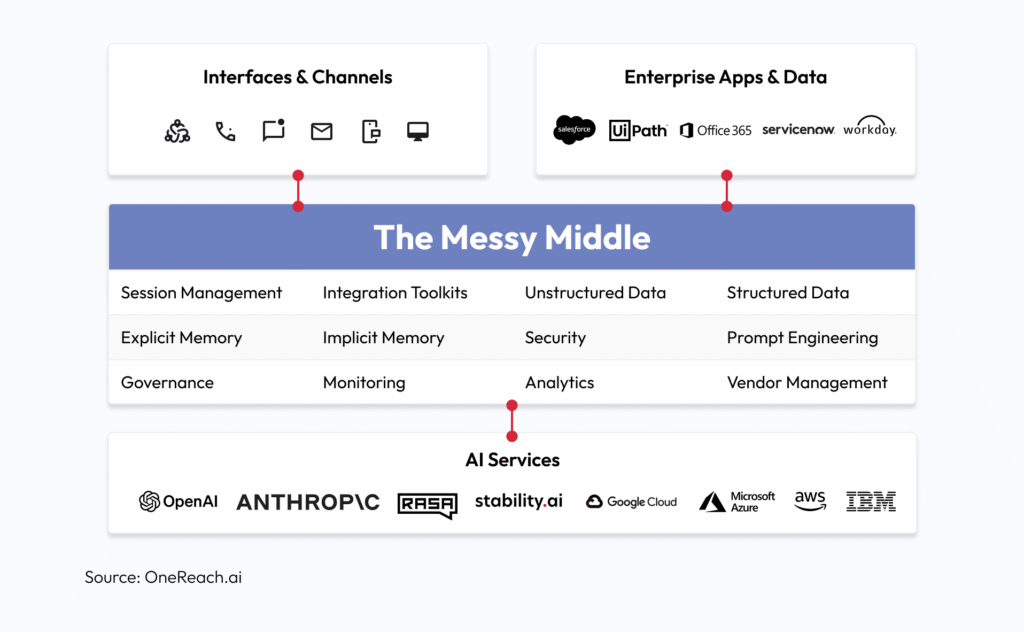
This is the messy middle: the hidden operational layer between your channels and your core systems where context evaporates, service-level agreements (SLAs) decay, handoffs get noisy, and routing rules collide. The problem isn’t a lack of touchpoints, it’s a lack of coordination. Organizations don’t need more channels; instead, they need a coherent way to manage work across every interaction and every team involved.
Multi-agent systems provide a pathway out. When multiple agents can coordinate within a single system or platform, sharing information and cross-checking outputs while maintaining state awareness, organizations truly have the ability to complete workflows autonomously. With the ability to govern agents, even those originating outside of your ecosystem, organizations can create reliable experiences that are truly omnichannel. Agent runtime environments provide this shared operating system, maintaining context, coordinating specialized AI and human agents, and enforcing guardrails end-to-end. Critically, the goal isn’t to just deploy agents; it’s to improve outcomes.
Why the Middle Is So Messy
The messy middle is where the promise of seamless automation hits the reality of legacy architectures, fragmented tools, and data trapped in silos. There’s no cohesive, end-to-end journey, just a patchwork of disconnected touchpoints that can’t see (or learn from) one another. For customers and employees alike, the messy middle is where trust goes to die.
Figure 1: The Messy Middle
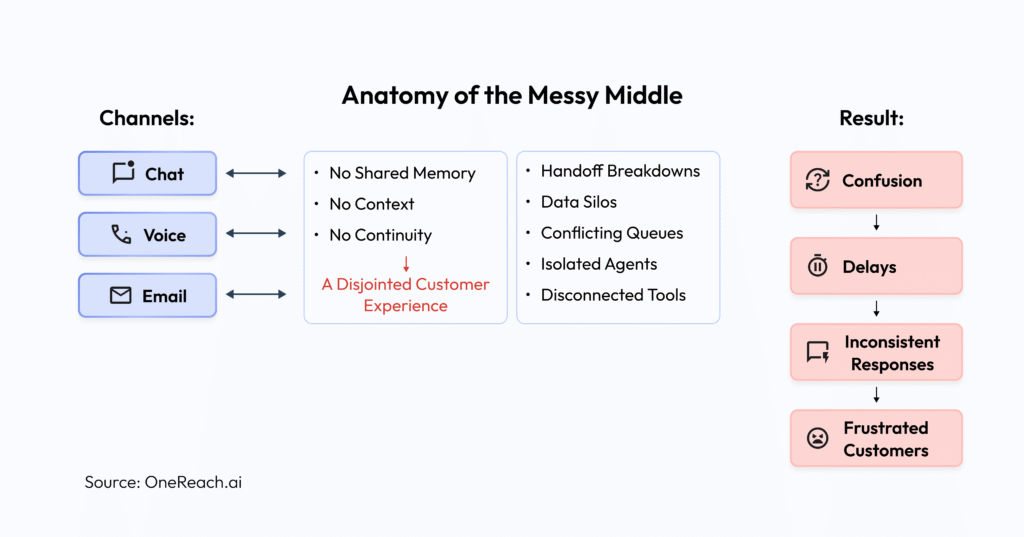
Anatomy of the Messy Middle
Returning to a customer journey as an example, someone starts in chat, escalates to voice, and follows up via email. Each interaction starts from zero. No shared memory. No context about what’s already been tried. No record of decisions or commitments made along the way. Behind the scenes, there are separate queues for each channel. Separate AI agents tuned to different use cases.
Separate CRM (Customer Relationship Management) integrations. Separate reporting stacks. With each system running its own data model and workflow logic, there are no coordinated handoffs. There’s no common workflow state and no reliable way for agents, human or AI, to inherit context from previous steps. The result is a ton of triage, inconsistent responses, and a customer experience that feels stitched together rather than designed.
Figure 2: Anatomy of the Messy Middle
The Cost of Fragmentation
This fragmentation has a cost, and it’s not abstract. SLAs erode as tickets bounce between teams and channels, every transfer requiring another round of discovery and clarification. Human agents spend a disproportionate chunk of their time reconstructing context that should already be there. They retrace the same ground across calls and messages until fatigue sets in. High-effort service experiences translate directly into customer disloyalty. The authors of The Effortless Experience found that, “96% of customers with a high-effort service interaction become more disloyal compared to just 9% who have a low-effort experience.”
Additionally, inconsistent answers across channels create audit and compliance vulnerabilities, especially in government and highly regulated environments. And while all this is happening, fragmented data and tooling make it nearly impossible to see the full picture. The patterns that could inform better automation, staffing, and experience design are buried in systems that don’t talk to each other.
Why Traditional Integration Fails
Most organizations have tried to fix the messy middle with more integrations: wire system A to system B, bolt on system C, etc. Point-to-point integrations like these create brittle dependencies, every connection is a custom relationship that breaks when one side changes its schema, API, or release schedule. Over time, the integration layer becomes a fragile web of one-off fixes. Expensive to maintain and nearly impossible to evolve.
Unified platforms promise to simplify this, but still run channel-specific logic. Each implemented voice flow, chat flow, email workflow has its own stack with its own rules, data models, and limitations. The platform unifies the interface and the reporting but does nothing to address the underlying cognition or workflow state. Adding a new channel or use case requires re-implementing logic instead of reusing what you’ve already built.
Similarly, a single agent designed for one channel or one narrow set of tasks can’t scale across modalities. It can’t support complex, multi-step workflows that span systems and teams. This kind of functionality requires an agent runtime. This can manage context, coordinate with other agents, and orchestrate processes that take longer than a single exchange. As clever front-ends to siloed back-ends, they are only useful in isolation. Without a runtime, agents don’t resolve the fragmentation, they decorate it.
AI agent orchestration for the enterprise
Learn more about OneReach.ai GSX platformHow Multi-Agent Orchestration Works
In the messy middle, most organizations still rely on point solutions or monolithic agents bolted onto legacy infrastructure. These systems try to handle everything — understanding intent, retrieving knowledge, executing transactions, escalating edge cases, but they do it in fragile, disconnected ways that don’t scale. As Robb Wilson, CEO and Co-Founder of OneReach.ai, puts it in Age of Invisible Machines, this approach leads to “a tangled heap of broken machines.” Each new tool increases chaos instead of capability.
The Shift From Single-Agent to Multi-Agent Architecture
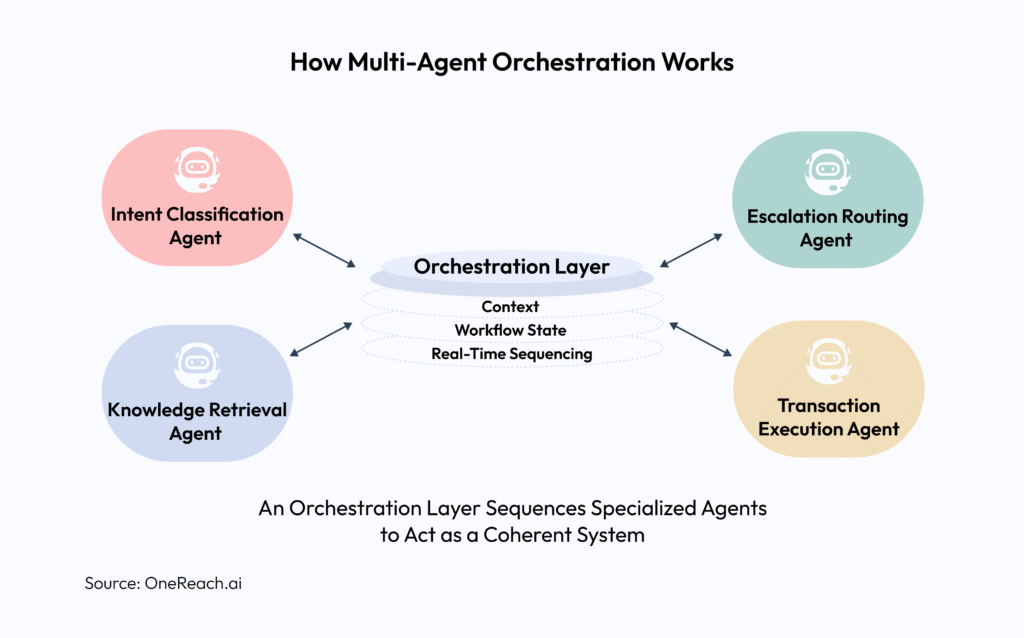
The way out is to stop thinking of automation as a single, all-purpose assistant. Think of it as an ecosystem of specialized agents. One agent focuses on intent classification. Another on knowledge retrieval. Another on transaction execution. Another on escalation routing. Instead of letting these agents operate as isolated point solutions, orchestration sequences their work in real time based on context and workflow state. That orchestration is what turns a collection of agents into a coherent system.
Figure 3: How Multi-Agent Orchestration Works
The Role of Agent Runtime Environments
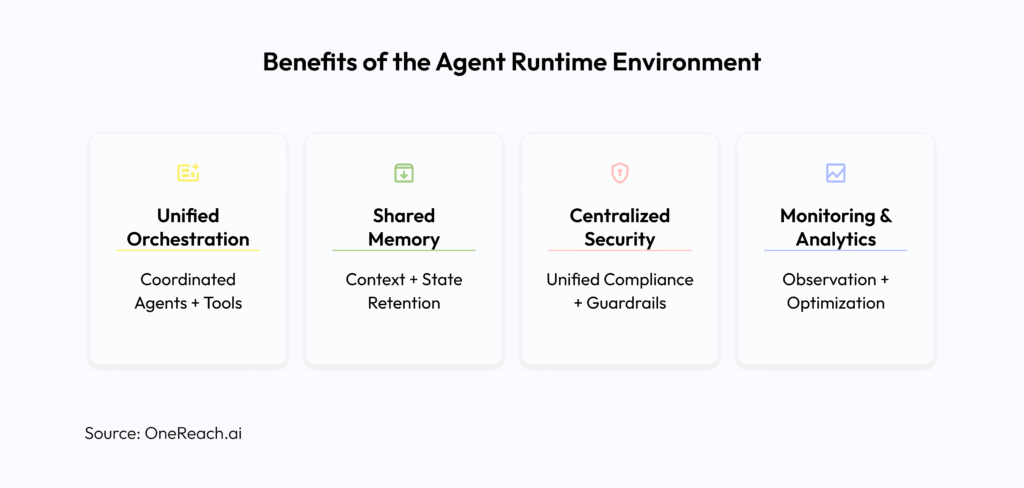
Multi-agent orchestration requires an underlying runtime, what Gartner describes as “an execution environment engineered to securely host and execute agentic applications.” The runtime manages agent lifecycles, shared memory, tool access, and inter-agent communication. It provides:
- Unified control and orchestration so agents, microservices, and tools can coordinate instead of collide,
- Context sharing and state management so every agent reads and writes to a unified view of the user, their history, and the current journey,
- Security, compliance, and guardrails enforced across the entire ecosystem, not left to each agent to handle on its own,
- Monitoring and analytics through central dashboards so teams can observe behavior, tune performance, and catch failures before they cascade.
Robb Wilson’s point, and it’s worth dwelling on, is that most failed AI projects are missing this key ingredient: an agent runtime environment. Without this shared operating layer, even sophisticated agents struggle with basic reliability, governance, and scale.
What This Looks Like in Practice
As PwC recently noted, “Many employees are using agentic features built into enterprise apps to speed up routine tasks … but it stops short of transformation.” In a mature organization, employees can build agents, connect them to verified organizational data, share them with colleagues, and put them to work on internal or external facing tasks.
For example, a customer initiates a billing dispute in chat. An intent agent classifies the request. A knowledge agent pulls account history. A transaction agent applies a credit. An escalation agent flags the case for human review if policy thresholds are exceeded. The same orchestrated flow executes whether the customer starts in chat, voice, or email, because the runtime maintains state across channels.
If the customer switches channels mid-journey, the shared context prevents the classic restart experience. Behind the scenes, inter-agent communication and workflow orchestration ensure specialized agents collaborate in real time. But what the customer experiences is a single, continuous conversation with the organization.
Similarly, employees can benefit from multi-agent orchestration eliminating their need to jump between apps to accomplish routine tasks. Runtimes empower organizations to leverage multi-agent orchestration across their operations.
Benefits of the Agent Runtime Environment
Agent runtime environments don’t just enable multi-agent orchestration and clean up the messy middle. They translate into measurable gains in speed, stability, and cost.
Figure 4: Benefits of the Agent Runtime Environment
Service Level Agreement (SLA) Improvement
When agents are orchestrated through a shared runtime, they carry context from one step and one channel to the next. No more asking basic questions over and over. No more re-collecting data that already lives in the system. Every interaction starts from a known state instead of from scratch. With less time wasted on repetition, more capacity opens up for complex, high-value cases. Obviously these capabilities have far reaching implications. Among them, SLAs improve along with customer satisfaction.
Operational Continuity
Agent runtime environments are designed for change. Because each agent runs inside a managed execution layer, individual agents can be updated, replaced, or taken offline without bringing down entire workflows. Built-in version control and rollback let teams test new models and behaviors safely, then revert quickly if something breaks. The runtime also standardizes behavior and policy enforcement across channels, which simplifies training and QA: validate a pattern once, see it applied consistently in voice, chat, email, and beyond.
Cost Efficiency
Offload low-value work like repetitive context gathering and basic routing to orchestrated AI agents. Let human agents focus on the work that actually requires judgment. This reduces the labor required per interaction and improves the quality of human engagement where it matters. At the same time, a unified runtime replaces the tangle of point-to-point integrations and channel-specific tools. This means fewer bespoke connectors, less platform overlap, lower maintenance burden, and more agility.
As more organizations adopt agent runtimes, metrics like faster resolution, fewer callbacks, higher first-contact resolution become the baseline for measuring AI-driven operations.
Turning AI Sprawl into a Coordinated System
If your organization is running multiple AI agents or planning to, this is the moment to ask whether you’re building toward coherence or compounding the agent sprawl.
Cross-channel chaos isn’t a channel problem; it’s an orchestration problem. Organizations need a way to make the systems they already have think and act together. Agent runtime environments are the missing piece. They give organizations a way to coordinate AI agents across every touchpoint with shared context, unified governance, and measurable outcomes.
Want to discover more AI runtime use cases for your organization?
Book a DemoFAQs About Multi-Agent Systems
1. How do multi-agent systems eliminate cross-channel chaos?
Multi-agent systems replace channel-specific logic with a shared orchestration layer that manages context, workflow state, and decision-making across interactions. Instead of each channel starting from scratch, orchestrated agents inherit context and coordinate their actions through a common runtime. This eliminates repetitive discovery, prevents broken handoffs, and turns fragmented touchpoints into a single, continuous journey.
2. Why isn’t traditional system integration enough to fix the messy middle?
Traditional integrations connect systems but don’t coordinate behavior. Point-to-point integrations are brittle, expensive to maintain, and tightly coupled to specific channels or workflows. When one system changes, the integration breaks. Multi-agent orchestration shifts the problem from wiring systems together to managing work across them, using a runtime that maintains shared state and governs how agents collaborate over time.
3. What makes agent runtime environments essential for enterprise-scale AI?
Agent runtime environments provide the operational foundation that agents need to run reliably at scale. They manage agent lifecycles, shared memory, tool access, security controls, and observability across the entire system. Without a runtime, agents remain isolated experiments. With one, organizations can enforce guardrails, reuse capabilities across channels, and move from disconnected AI deployments to a coordinated, enterprise-grade system.