

There is a specific kind of discomfort that comes with a certain kind of success.
You distributed the Copilot licenses. Signed the SaaS renewal that includes some new AI features. Someone put together a slide for the board and it looked good. The CEO nodded.
And yet.
Something doesn’t add up. You can feel it, even if you can’t name it in a meeting. The needle hasn’t moved. Not really. Not the needle that matters.
That feeling is actually data. Don’t dismiss it.
I spend a lot of time with enterprise leaders who are navigating exactly this moment. And I want to be honest about what I keep seeing, because that feeling is quickly turning into hard conversations.
Personal productivity tools are real. The capability improvements are genuine. But here is the thing about a tool that makes an individual more productive: it metabolizes work and excretes time, but it is up to the individual to harness that time into something productive for the company. This is hard to measure, and not showing up on your P&L.
Gartner recently published research that maps the distribution of AI agents deployed across enterprises today. The vast majority are what they call “ad hoc, transient, disposable.” These are productivity agents constrained by the category of work they were built to touch. The chart looks like a power law curve dropping fast to the right. Lots of agents with short lives. A small tail of engineered, long-lived agents that actually carry mission-critical weight.
Most enterprise AI today investment is concentrated at one end of that curve.
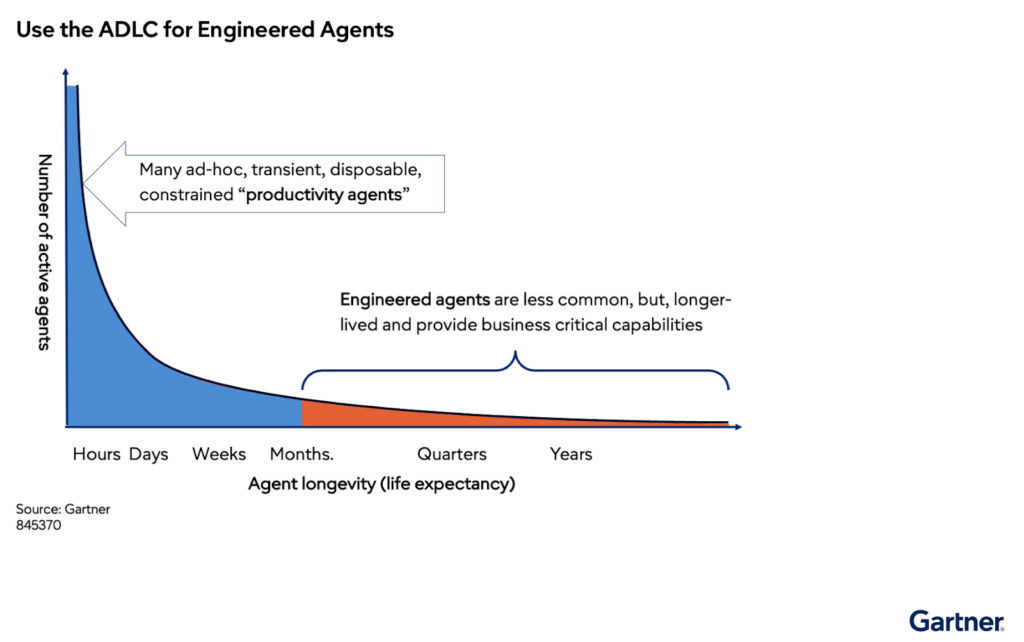
Source: Gartner, “How to Build Successful LLM-Based AI Agents,” Gary Olliffe and Manjunath Bhat, 20 March 2026, ID G00845370. Reprinted with permission.
More productive individuals are not a transformed organization.
Here is the part that rarely gets said out loud: the investment in productivity tooling isn’t just limited in what it produces. In many organizations, it is actively working against what comes next.
This is not a product critique. It’s a structural observation.
When individual tool licenses are distributed and adoption is measured, something institutional happens. The spend is real. The users like the tools. They help people personally, and that’s something. But those users are not incentivized to advocate for replacing the underlying work. They are, naturally, advocates for the status quo that now includes the tool they use.
The organizations that made this investment in good faith now find themselves further from the goal, not closer to it. It is not that the tools failed; it is that they succeeded at the task of individual productivity but did so at the expense of the bigger opportunity. By solving for individual productivity instead of larger systemic change, they have consumed their strategic capacity.
That is the pit in your stomach talking.
There is a difference between assisting work and making it invisible.
I want to offer a different frame for what AI is actually capable of at its highest order.
There are two fundamentally different things AI can do for an organization. One is to assist the worker: faster, smarter, more capable individual output. Useful. Real. Limited. The individual still exists inside the same process, serving the same function, inside the same organizational logic that produced the inefficiency in the first place.
The other is something even more transformative. Not just making an inefficient process faster, but dissolving it entirely. Making the work invisible. Satisfying the original goal of a function in a way that renders the embedded tasks beside the point. Returning time not only to the individual, but to the organization.
That distinction matters.
I’ve read the criticism that most agentic AI is being architected for a clean, fictional enterprise. One with unified data, coherent systems, modern operational layers, clear governance lines. That enterprise doesn’t exist. Most enterprises are brownfield. The data is messy. The systems don’t talk to each other. The integration layer is cobbled together by institutional memory and legacy decisions no one fully remembers.
The answer to that is not to wait. It is to build infrastructure that was designed for the mess. That governs, coordinates, and compounds despite the complexity, not in spite of it.
That is an engineering problem. And it is solvable. But it requires a different investment decision than the one most organizations have been making.
The mess is the starting point.
Beyond metabolizing existing work, there is a third category that is underappreciated or perhaps considered too ambitious for some: AI pursuing a goal the organization couldn’t previously pursue at all.
Not optimizing a function. Not replacing a task. Creating a new capability, a new product, a new line of revenue that simply wasn’t accessible before.
That is where enterprise ROI becomes transformational. Not in the 15% productivity lift distributed across individuals who then spend the reclaimed time on other tasks. Not in cost reduction alone, or headcount decisions made because someone ran out of imagination about what else was possible.
This quote from Nvidia’s Jensen Huang is worth sitting with,”If your CEO is using AI to cut headcount, it means one thing: They have no imagination. They have no vision for what comes next. They got handed the most powerful tool in human history & their FIRST instinct was to fire people.”
The most competitive organizations have stopped collecting AI point solutions and started building the infrastructure to outrun them.
Some of the organizations I work with are under genuine pressure. Perhaps even existential pressure. An industry in structural crisis. Software companies watching AI commoditize their core offering. Companies with their backs against the wall.
What strikes me about the best of them is that they are not taking the easy path. They are not satisfied with achieving their “AI Merit Badge” by allocating Copilot licenses.
The first, a financial institution in an industry experiencing margin compression, consolidation pressure, and fintech disruption on every side, made a clear-eyed decision. Personal productivity gains were never going to answer what they were facing. They chose to invest in agentic infrastructure that could produce something new. Not: optimize for survival. Instead: build for growth.
Another, managing a software portfolio, came to the same conclusion about AI-assisted code generation. The question was never how to write code faster. The question was how to deploy a new class of AI-native solutions that open new markets. They are building toward that. On a platform. Not just more ‘random acts of AI.’
These are not reckless organizations. They are not ignoring the complexity in front of them. They are choosing to build on infrastructure that was designed for the enterprise they actually have while still demanding that the outcome be something that actually moves the needle.
You already know the licenses weren’t enough.
I’ll close the way I opened, because I think it matters.
If you have that feeling. The licenses and the adoption metrics and the board slide aren’t quite adding up to the transformation you signed up for. Trust it.
Not because the tools you’ve deployed are bad. Not because you made a wrong decision. But because you are in a position to make a different one now, with more clarity about what the category of AI assistants can and cannot produce.
The organizations that will see real, durable enterprise ROI from agentic AI are not the ones with the cleanest data or the most tenured vendor relationships.
They are the ones honest enough to name where they actually are — and courageous enough to demand infrastructure built for where they are going.
That is not a small thing to ask for. But it is the right thing to ask for.
And I think you already know that.
First published on Linkedin here: https://www.linkedin.com/pulse/ai-merit-badge-longer-enough-kevin-fredrick-porvc/.