Key Takeaways:
- An AI agent management platform (AMP) organizes and monitors all aspects of agentic AI.
- The real differentiator in AI agent management platforms is shared governance, observability, and cross-enterprise orchestration.
- Without a unified control plane, AI agents quickly become fragmented and unmanageable.
According to Deloitte’s State of AI in the Enterprise survey, nearly 3 in 4 (74%) companies plan to deploy agentic AI within two years, yet only 1 in 5 (21%) report having a mature model for governance of autonomous agents, raising the specter of unintended risks.
Imagine a CIO at a $10B global organization who has run an internal census across the enterprise. The count of AI agents already in production across the business is 452. Not in pilots, but in production. Central IT is only aware of 68 of them: those formally integrated into ServiceNow, a core system. The rest have been launched by departments responding to the same board-level mandate: move fast on AI, prove value, deploy agents. Most of them work, but they don’t communicate with each other. None are coordinated. None report into a central security or audit trail.
Gartner predicts that by 2028, an average global Fortune 500 enterprise will have over 150,000 agents in use, up from fewer than 15 in 2025, generating significant AI agent sprawl, IT complexity, and management challenges.
This is what an AI agent management platform is built to address. It’s the production-grade software that governs the full lifecycle of agents inside an enterprise, covering AI agent development, AI agent testing, AI agent evaluation, AI agent deployment, and AI agent orchestration under a single control plane.
What Is an AI Agent Management Platform?
An AI agent management platform (AMP) is a software environment in which an AI agent lifecycle happens under a unified governance model. Gartner defines it as “a platform that organizes and monitors all aspects of agentic AI. This platform should encompass security, ROI, governance tools, and libraries of prebuilt agents. It should also manage the enterprise’s relationships with AI agent marketplaces where agents can be bought and sold.” It is distinct from an agent builder, which is a point solution for creating individual agents one at a time.
An AI agent management platform sits above the application and cloud layers. It decides which agents act, in what sequence, under what policy, and reconstructs the decision trail when something goes wrong. This layer functions as the control plane.
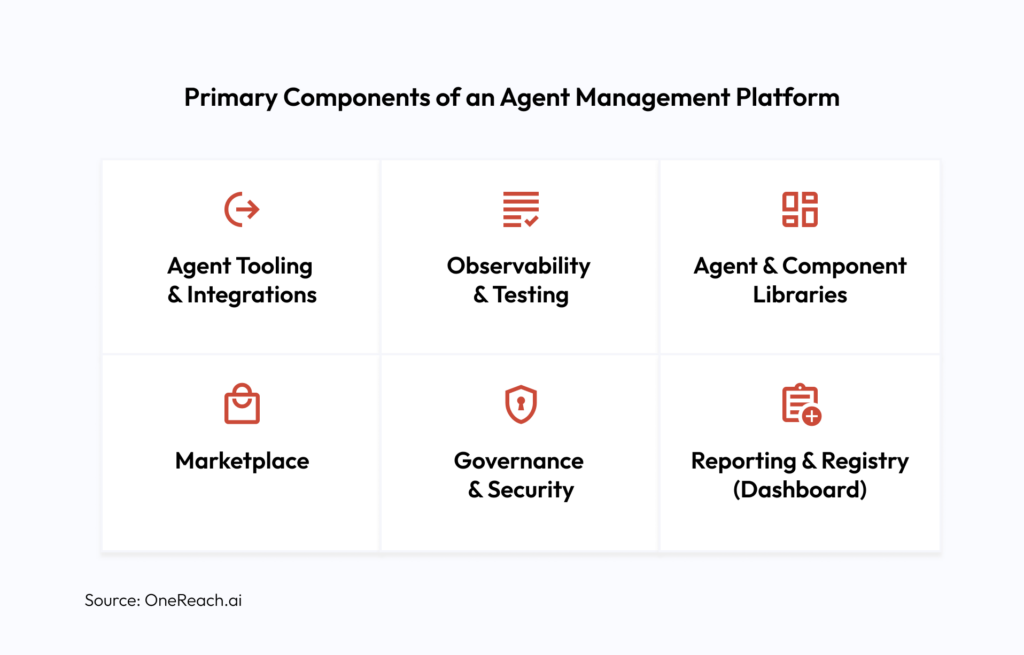
Figure 1: Primary Components of an Agent Management Platform
What to Look for in an AI Agent Management Platform
An AI agent management platform provides orchestration and governance layers to run your entire agent population as one coordinated system. That is its primary job. The agent lifecycle is the most practical way to navigate what an AMP has to support: walk one agent from idea to production, and you can see where the platform has to earn its keep at each stage. There are six stages to cover.
Figure 2: Agent Lifecycle Management
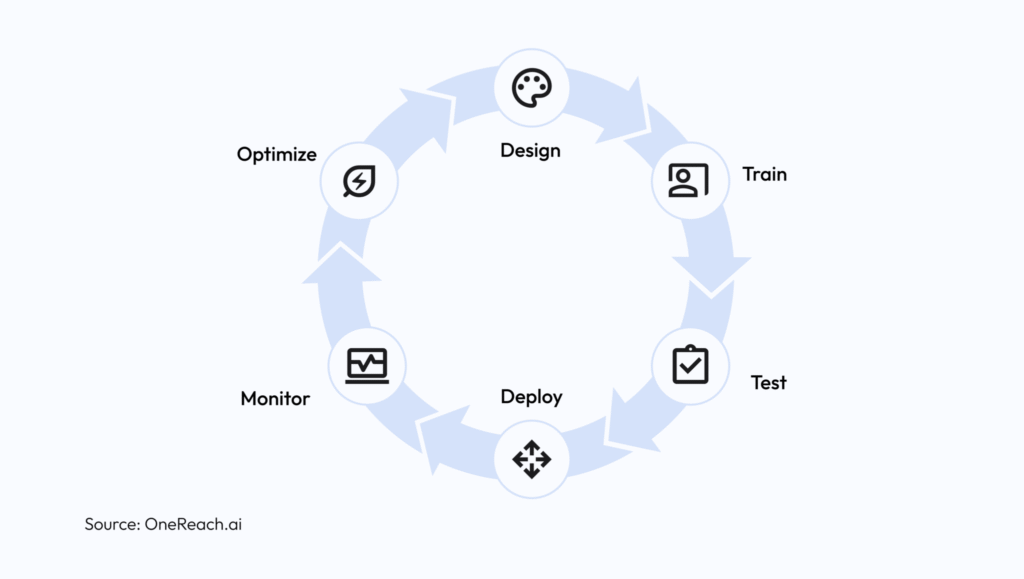
- Design. This phase defines the business problem the agent will solve, the decisions it can make, the boundaries of its autonomy, and the human-in-the-loop checkpoints that govern it.
- Development. It is where the agent acquires its knowledge and skills through data preparation, model training, and knowledge-base integration, supported by automated pipelines and model versioning.
- Testing (including regression testing). It validates the agent’s behavior across unit, integration, performance, bias, and security checks, and ensures that any new deployment produces the same results as previously verified versions. Regression testing also happens whenever changes are made to the agent or the model.
- Deployment. It is when AI agents are validated for production and start creating business value. Production rollout, systems integration, user onboarding, and go-live support require an agent platform capable of managing complex deployment scenarios.
- Monitoring. It provides a continuous view of AI agent performance, behavior, outputs, and business outcomes by tracking factors such as bias, drift, accuracy, consistency, latency, and overall operational impact.
- Optimization. This stage enables ongoing improvement through performance tuning, retraining models, feature enhancement, and support for feedback loops.
The lifecycle tells you what to look for, but it is not the whole of what an AMP does. Above the stages, orchestration acts as the control plane that coordinates decisions, memory, and authority across the entire agent population. This is where an AMP does its heaviest work, and it depends on a set of operational capabilities, including security, a library of prebuilt and pre-governed agent components, builder tooling, operator dashboards, marketplace integration, and observability.
Observability is the most demanding of these. It covers testing, lifecycle monitoring, runtime performance, and audit. Without it, governance is just documentation, not real control.
A platform that handles one or two of these stages is a builder. A platform that handles all six under unified governance, with orchestration above them, is an AI agent management platform.
Why Companies Who Fail to Control AI Agent Sprawl Will Fall Behind Forever
Learn MoreHow to Choose an AI Agent Management Platform
The following three questions usually cut through most procurement decks:
- Where does the platform sit in the stack? A platform inside an application or a single cloud will govern only what is inside that application or cloud.
- What does governance enforce, and when? Governance configured after deployment is documentation. Governance enforced at the architecture level applies to every agent, including those built outside the platform.
- Does it deploy or orchestrate? Deployment is a checkpoint. Orchestration is the operating model.
The 5 End-to-End AI Agent Management Platforms in 2026
Microsoft Copilot Studio
Copilot Studio is an end-to-end conversational AI platform for building, customizing, and publishing autonomous AI agents. It offers deep native integration with Microsoft 365, Power Platform, and Azure AI, and is the natural choice for organizations standardized on the Microsoft ecosystem. For enterprises whose agent workloads live primarily inside that stack, the governance posture is coherent and well-supported. Where it gets complicated is at the boundary. Enterprises running agents across multiple clouds, non-Microsoft applications, or departments outside the Microsoft estate typically end up managing governance frameworks in parallel rather than from a single layer.
Salesforce Agentforce
Agentforce is purpose-built for Salesforce data and workflows. It integrates deeply with the Agentforce 360 Platform, combining internal and external data with the Einstein Trust Layer, and the low-code framework lets revenue operations teams reuse existing platform tools like Flows and Apex. For organizations whose agentic workloads center on CRM, that is sales, service, customer engagement, Agentforce is genuinely strong. The constraint appears when the agent estate expands beyond the customer record. HR, finance, supply chain, and cross-functional workflows that don’t live in Salesforce require integrations that sit outside the governance model, which means the control plane fragments as the program scales.
IBM watsonx Orchestrate
IBM watsonx Orchestrate is an enterprise AI automation platform for building, deploying, and managing AI agents across business workflows, designed to operate alongside watsonx.governance for monitoring, risk management, and compliance. The separation of orchestration and governance into distinct products is a deliberate architectural choice that reflects IBM’s broader enterprise stack philosophy — and for organizations already operating inside IBM Cloud and hybrid IBM environments, that integration is coherent. The diagnostic question is whether governance enforced across two coordinated IBM products produces the same architectural unity as governance enforced at the platform layer. Enterprises that are not already IBM-aligned should also evaluate the integration overhead before assuming the full governance posture applies to their existing stack.
Kore.ai
Kore.ai has heritage in conversational AI and customer service, and its Artemis platform introduces a structured approach to agent governance through its Agent Blueprint Language, which allows organizations to define, validate, and control agent behavior in a standardized, auditable way. For teams that want structured agent design with explicit behavioral controls, that’s a meaningful capability. The question of the diagnostic surface is where in the stack it sits. Kore.ai launched its dedicated AMP in early 2026 with cross-framework ambitions, but the platform’s depth is still concentrated in the conversational and customer service layer. Enterprises evaluating it for broad cross-departmental orchestration should pressure-test how governance behaves outside that domain.
OneReach.ai Generative Studio X (GSX)
GSX is the cloud-agnostic, model-agnostic control plane for governing the enterprise AI program across every vendor, framework, and cloud. It does not replace the existing stack. It governs it.
Where application-centric platforms govern within a silo and hyperscalers govern within their own ecosystem, GSX sits above all of them. Governance is enforced at the architecture level before deployment, not configured after the fact. Private Dedicated Environments provision GSX exclusively for each organization, isolated at the network, compute, storage, and data layers, deployable directly into the customer’s own AWS account. Pass-through model pricing means customers pay model providers at cost rather than absorbing a platform markup.
The honest constraint is fit. GSX is infrastructure, not a packaged application. Organizations that need agents embedded in a single platform for a defined workload may find purpose-built solutions faster to stand up for that specific use case. GSX is the right choice when the agent estate spans more than one domain, more than one cloud, or more than one vendor, and when governance must be consistent across all of them.
The View From Mission Control
According to Gartner, by 2027, 75% of enterprises will consider the methodology they use to monitor AI agents their most important AI tool, up from 1% today, and by 2029, enterprises will spend $15 billion on AMP technology, up from less than $5 million today.
So, what is the solution to the problem of 384 unaccounted agents? The answer is not fewer agents. It is the governance layer beneath them that can see them, reason about them, and govern their behavior across the enterprise. In other words, CIOs need an AI agent management platform that provides shared governance, observability, and orchestration across the entire agent population.
Why Most AI Agent Orchestration Is Just Sequencing With a Better Demo
Learn MoreAnalysis current as of June 2026. Platform capabilities and corporate ownership change quickly; verify specifics with vendors before purchase.
FAQs
1. What is an AI agent management platform?
An AI agent management platform is an enterprise software that governs the full lifecycle of AI agents, from design and development to deployment, monitoring, and optimization. Unlike standalone agent builders, it provides centralized orchestration, governance, and observability across all agents in an organization. This allows enterprises to coordinate agents, enforce policies, and maintain auditability across complex multi-agent environments.
2. How is an AI agent management platform different from an AI agent builder?
An AI agent builder focuses on creating individual agents or workflows, often within a specific application or ecosystem. An AI agent management platform operates at a higher level: it manages many agents across systems, ensures they follow governance rules, coordinates their actions, and provides visibility into their behavior. In short, builders create agents, while management platforms control and orchestrate them at scale.
3. Why do enterprises need AI agent management platforms in 2026?
Enterprises are scaling from dozens to thousands of AI agents across departments, which creates fragmentation, lack of visibility, and governance risk. AI agent management platforms address this by providing a unified control plane for security, orchestration, observability, and lifecycle management. This becomes critical as organizations move toward large-scale agentic operations, where unmanaged agent sprawl can directly impact compliance, cost, and business performance.