
Key Takeaways:
- Composite AI is the practice of combining multiple AI techniques, models, and deterministic software into a single architecture, so each part covers a specific function.
- A standalone LLM is a strong language interface but a weak decision engine, which is why enterprises are moving from single-model deployments to composite architectures for any high-stakes business process.
- The deciding factor in whether composite AI succeeds is the orchestration layer that coordinates its parts and keeps every decision auditable. Without it, a composite system fragments into agent sprawl.
As AI moves more directly to the center of the enterprise technology stack, organizations are shifting away from point solutions for single tasks toward integrated systems that function like coordinated teams. In these systems, different AI components specialize, collaborate, and operate in sync to run workflows, analyze data in real time, and support autonomous decision-making.
Composite AI is the practice of combining multiple AI techniques, models, and deterministic software into a single architecture, so each part covers a specific function. This is in contrast to a single form of artificial intelligence. Gartner projects that by 2029, annual AI services spending will reach $516 billion, with composite AI accounting for 66% of it. In four years, an approach that is today rarely separated out in AI services spending breakdowns will become a dominant share of those budgets.
Moreover, at the Gartner Data & Analytics Summit 2026 in Orlando, Erick Brethenoux, Distinguished VP Analyst and Chief of Research at Gartner, named composite and neurosymbolic AI as one of the trends shaping the future of AI, describing it as AI composed of multiple data-driven and knowledge-driven techniques.
For enterprise architects, the spending forecast and analyst conviction indicate that the single-model era is giving way to assembled intelligence. What follows are examples of what composite AI is, how it differs from a single-model approach, and what it takes to run safely at enterprise scale.
What Is Composite AI in Simple Terms?
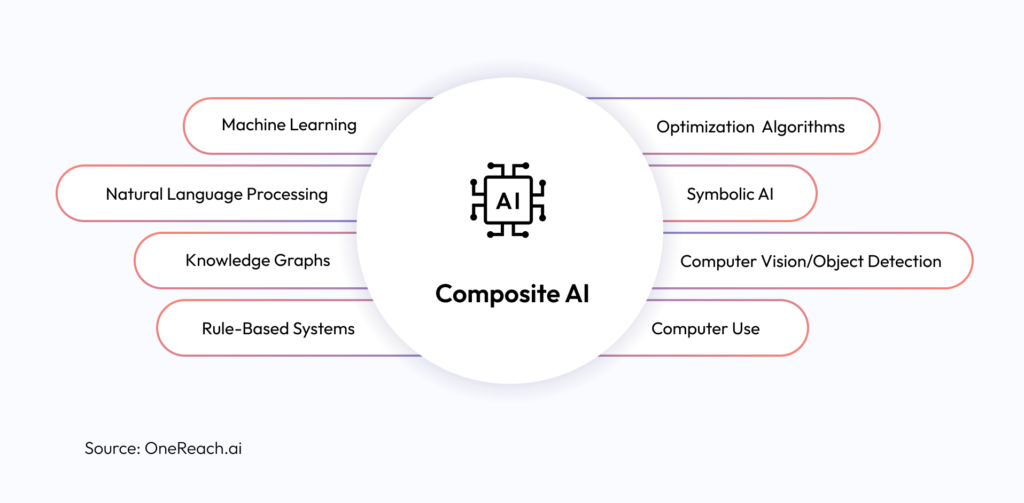
Figure 1: Composite AI
A large language model, in the context of generative AI, is great at predicting human language based on its training data. While this is useful, it limits the practical use of generative AI when an enterprise tries to automate business processes with a language model alone.
The technology isn’t inherently good at following rules, consistently delivering matching values, and holding state. Composite AI keeps the language model where it’s good and surrounds it with techniques that are good at keeping consistency, memory, and rules across processes. Figure 1 shows the components a composite system usually includes:
- Machine learning finds patterns and makes predictions from historical data, such as fraud scoring, demand forecasting, or churn prediction.
- Natural language processing interprets and generates human language so people can interact with the system in plain words.
- Knowledge graphs connect facts and the relationships between them, so the system reasons from verified information.
- Rule-based systems apply fixed, human-defined conditions that return the same result every time and can be audited line by line.
- Optimization algorithms find the best option against a set of defined constraints, such as routing, scheduling, or pricing.
- Symbolic AI reasons over explicitly encoded knowledge and logic rather than learned statistical weights, which makes its conclusions traceable.
- Computer vision/object detection reads images and video to identify objects, text, or anomalies, such as a defect on a production line or a finding on a medical scan.
- Computer use carries out repetitive, deterministic actions across existing software, such as moving data between systems or completing a form.
That is the idea behind composite AI as a category: no single technique is enough, so you compose. Gartner defines it as “composite AI, also known as hybrid AI, refers to the combined application (or fusion) of different AI techniques to improve the efficiency of learning and broaden the level of knowledge representations. It broadens AI abstraction mechanisms and, ultimately, provides a platform to solve a wider range of business problems in a more effective manner.”
If the techniques above are the inputs, the outputs are what an organization sees and uses. A composite system draws on data sources such as databases and document stores, cleans and processes that data, and turns the combined work of its components into operational results:
- Dashboards present what the system found and decided in a form people can monitor and report on.
- AI agents act on the system’s conclusions, carrying tasks through other systems and channels.
- Recommendations surface suggested next actions for a person to review and approve.
- Automated decisions let the system act on its own within defined boundaries, such as approving a low-risk transaction or routing a support ticket.
- Alerts flag the cases that need human attention, from an anomaly in the data to a threshold being crossed.
This is where OneReach.ai Generative Studio X (GSX) platform fits into a composite AI architecture. GSX functions as a control plane for multi-agent composite AI systems, coordinating how models, agents, rule engines, and enterprise workflows work together. The platform is configurable to each organization’s needs, providing the orchestration, governance, context management, and observability needed to turn composite intelligence into a single, accountable system.
What Makes Composite AI Different from a Single-Model Approach?
A monolithic AI approach routes everything through one model and hopes it generalizes. In a composite AI system, a model is just one of many components. The difference shows up in three places that shape any enterprise AI strategy:
- Flexibility. Because composite intelligence is modular, you can swap a model, add a rule engine, or change a data source without rebuilding the application around it. A monolithic design locks you to one vendor’s model and one vendor’s roadmap.
- Scalability. In a composite AI system, scale is about doing the same thing correctly millions of times. For example, a large bank processes tens of millions of transactions each day, and every transaction must have the same rule applied in the same way. A generative model alone can’t guarantee that due to its probabilistic nature. A composite system routes high-volume, precision-critical tasks to deterministic components and reserves the language model for activities that benefit from interpretation, ensuring accuracy and repeatability as volume grows.
- Governability. A single model is a black box you audit after the fact. A composite system has seams you can inspect, log, and control at every step. That is why composite AI is an architectural argument.
What Is Enterprise AI Governance?
Learn MoreThe clearest examples come from work where a wrong answer carries a cost:
- In fraud detection, an LLM analyzes transaction descriptions, customer communications, and other unstructured data to identify suspicious patterns that may warrant investigation. A machine learning model scores transactions for fraud risk based on behavioral and transactional signals. A rules engine then evaluates the transaction against regulatory requirements, known fraud schemes, and internal policies, while an AI agent determines whether to approve the transaction, block it, or escalate it to a human investigator. The LLM provides contextual understanding, the machine learning model detects anomalies, and the deterministic components ensure consistent decision-making.
- In clinical decision support, an LLM summarizes physician notes, lab reports, and other unstructured patient records. Computer vision analyzes medical images such as X-rays or MRIs to identify potential abnormalities. A knowledge graph connects those findings to patient history, clinical guidelines, and medical literature, while a rules engine checks recommendations against established treatment protocols and safety requirements. Together, these components produce evidence-backed recommendations that a clinician can review and approve. The LLM interprets language, the computer vision analyzes images, and the knowledge-driven components provide traceability and clinical validation.
Enterprise operations show the pattern at scale. McKinsey describes an IT service desk that embedded AI agents across roughly 450,000 tickets a year, automating up to 80% of requests and moving half of its capacity to higher-value work.
Enterprise teams now redesign infrastructure around modularity, composability, and orchestration, which is composite AI in architectural terms.
What Does Composite AI Require to Run Safely at Scale?
Composition creates a new challenge. Once an organization has many specialized workflows, agents, and rule layers, it needs a platform that can coordinate them, enforce policy, and record what happened.
That coordination layer is the control plane. It decides which component runs when, passes information between them, and keeps a record of every step. With it, a composite AI system behaves like a single accountable program that can be run and audited. Without it, a composite AI system becomes a set of disconnected parts and fragments into sprawl.
IBM research quantifies the payoff: enterprises that build an AI orchestration layer are 13 times more likely to scale AI successfully and cut AI-related issues by nearly a third. This is the layer OneReach.ai GSX operates in. The platform acts as a control plane for multi-agent systems, including both deterministic rule-based programming and probabilistic AI capabilities. It governs which models, services, and rule-based components an agent can invoke, carries context across the architecture, and keeps every decision observable and accountable.
Composite AI supplies the techniques. The orchestration layer turns those techniques into one coordinated, governable program.
Best Practices for Using Composite AI
Most composite AI failures come from skipping the architecture and jumping straight to model selection. These practices, drawn from Gartner’s guidance for enterprise architects, keep the system governable as it grows.
- Do not embed critical business logic in an LLM prompt. Wrap LLMs in predictable, rule-based layers. Use Bayesian networks for probabilistic reasoning and decision trees or Markov decision processes for auditable workflows.
- Start with a pilot composite pattern. Fuse retrieval-augmented generation (RAG) with a traditional rule engine in one business unit before scaling across the enterprise.
- Match placement to risk. Run sensitive or regulated tasks on-device or in a sovereign cloud; reserve the global cloud for open-ended, low-sensitivity work.
- Establish AI-specific financial controls early. Embed adaptive spending guardrails into the architecture itself, so agents that exceed token-consumption thresholds trigger alerts or get blocked automatically.
- Bring in an orchestration layer before agent sprawl sets in. Agent management platforms give you a single control plane across diverse, specialized agents.
Building Enterprise AI with Composite Intelligence
Composite AI describes how serious enterprise AI gets built: several techniques, each placed where it performs, coordinated and governed as one system. The direction is already funded, and the wider analyst view treats orchestration and governance as the deciding factor in whether agentic systems hold up in production.
What should enterprise architects do next? Decide which techniques each workload needs. Place each model where its risk profile allows, from on-device to sovereign cloud. Then put a control plane underneath the whole program, so coordination, policy, and auditability hold as the system grows. That is the difference between a collection of capable models and an enterprise AI strategy you can stand behind.
Why Enterprises Need an AI Control Plane for Agentic Systems
Learn MoreFAQs
1. What is composite AI?
Composite AI is the combination of multiple AI techniques and models, such as large language models, machine learning, knowledge graphs, and rule-based logic, into one architecture. Each technique compensates for the limits of the others, which makes the overall system more reliable and more governable than any single model.
2. How is composite AI different from generative AI?
Generative AI is one technique: models that produce text, code, or images. Composite AI is an architecture that can include generative AI alongside other methods. In practice, a composite system uses a generative model for language and pairs it with deterministic and analytical components for decisions that must be consistent and auditable.
3. What does composite AI mean for enterprise architecture?
It makes intelligence modular. Architects can place each model where it fits, swap components without rebuilding, and govern the whole system through a single orchestration and control layer.