Consider a regional bank with 15,000 employees deploying an AI agent to triage internal IT tickets. The agent sits inside Jira Service Management, reading incoming employee requests. It works. Resolution times drop, the help desk team stops drowning, and the project gets cited on the next earnings call as proof that the AI strategy is delivering results.
Fast-forward a year. During a routine compliance review, an auditor asks a straightforward question: Why did this agent grant a third-party contractor access to a legacy financial reporting system, and what was the chain of reasoning? Nobody can answer. The agent has been quietly updated three times, the retrieval-augmented generation (RAG) data pipeline has changed, two tool integrations were deprecated and swapped without documentation, and logs were rotated out after 90 days. The agent is still running. The accountability is not.
This is where AI agent runtime platforms can help close the gap. Launching an agent is the easy part. Operating it responsibly at scale is where organizations can struggle.
According to the 2026 Gartner CIO and Technology Executive Survey, only 17% of organizations have deployed AI agents to date, yet more than 60% expect to do so within the next two years. At the same time, Gartner predicts that over 40% of agentic AI projects will be canceled by the end of 2027, citing escalating costs, unclear business value, and inadequate risk controls. Those are not technology failures. They are lifecycle failures.
What Is Agent Lifecycle Management?
Agent lifecycle management is the operating framework for managing AI agents from conception through deployment, operationalization, and ongoing optimization. Unlike a traditional software solution, which is linear and follows a build, deploy, maintain, and manage approach, the agent lifecycle is a more continuous loop, where each phase has ramifications on the phases that follow. It provides a structured approach for managing AI agents throughout their evolution.
Instead of treating an agent as a one-time deployment, agent lifecycle management provides a continuous, iterative framework that ensures agents evolve alongside changing business needs, technological capabilities, and regulatory requirements.
The AI agent lifecycle management framework comprises six key phases: design, train, test, deploy, monitor, and optimization. Each of these phases helps ensure that AI agents provide continuous value while maintaining compliance, security, and operational excellence. What distinguishes an agent lifecycle in enterprises is the scale, risk, and complexity it brings along. A single poorly performing agent can impact thousands of customer interactions, expose sensitive data, or create regulatory violations before anyone notices.
Evaluation and observability become essential deliverables. Without lifecycle discipline, agents fail at scale repeatedly, across an immense surface area. Enterprises that implement structured agent lifecycle management frameworks gain significant competitive advantages over those that treat agents as standalone deployments.
The Six Stages of Agent Lifecycle Management
Figure 1: Agent Lifecycle Management
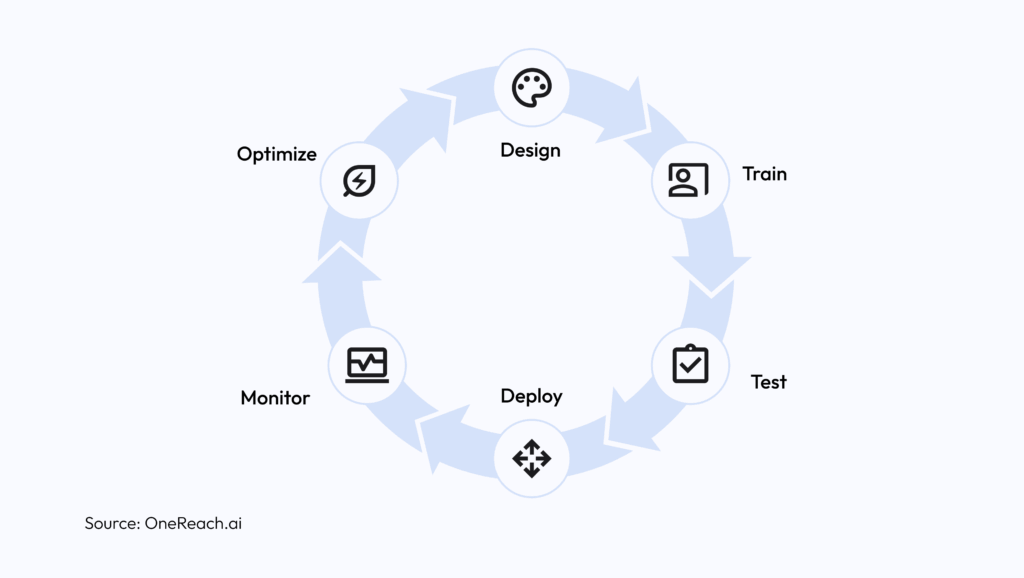
These six stages form the enterprise automation lifecycle that ensures AI agents deliver sustained value at scale.
- Agent Design Phase
The design phase establishes a strategic foundation for pursuing clear goals, functional and non-functional specifications, and architectural plans, all of which must address organizational objectives. The design phase encompasses requirements development, use case definition, architecture development, and stakeholder alignment, all of which require collaborative development environments with versioning and documentation capabilities.
To design an effective agent, the starting point is a clear definition of what business problem the agent will address. Organizations must ask fundamental questions: What specific task will this AI agent be automating? Who will use the agent? What decisions will the agent be able to make? And finally, what level of autonomy does the agent need? Having this clarity prevents wasted investment in misaligned projects while ensuring development efforts are focused on high-impact use cases.
Designing the agent’s architecture involves selecting the right AI models, defining tool integrations, establishing data access patterns, and creating workflow mappings. The architecture must explicitly address safe operations, transparency, and accountability in every decision and action. This includes implementing mechanisms for human-in-the-loop (HitL) interventions and emergency override capabilities to stop the agent if necessary.
- Agent Training Phase
In the training phase, AI agents acquire the knowledge and skills needed to accomplish their assigned tasks. This includes data preparation, model training, integrating knowledge bases, and testing samples, all of which require automated data pipeline management and model versioning systems. A successful training process ensures the agents can comprehend context, make informed decisions, and carry out the task reliably.
Training starts by identifying, collecting, and preparing high-quality datasets that reflect the scenarios the agent will encounter in production. The data needs to be cleaned, normalized, labeled correctly, and checked for potential bias. Recent research by EY indicates that 36% of CIOs believe their data platform infrastructure is not adequately prepared, highlighting the importance of this step for ensuring AI agent reliability.
Effective training employs iterative development methods that allow agents to be iteratively improved based on what they learn from sample interactions. The reflection design pattern enables language models to assess their own outputs, creating cycles of self-improvement. This iterative method allows AI agents to learn from their mistakes and improve both accuracy and reliability over time.
- Agent Testing and Evaluation Phase
The testing phase is the third stage that validates AI agent performance across multiple dimensions before production deployment. Unit testing, integration validation, performance assessment, and security evaluation all require comprehensive testing frameworks tailored explicitly for AI agents. This thorough validation reduces the risk of failures, biases, and security vulnerabilities in production environments.
AI agents require thorough testing across core dimensions to ensure accuracy, reliability, and security. Unit tests validate core components such as intent detection, entity extraction, and system actions. Functional and integration testing validate that multi-turn conversations, workflows, and back-end dependencies function smoothly in real-world scenarios. Performance and load testing measure how the agent behaves under stress, evaluating its speed, scalability, and stability.
To be deployed responsibly, the AI agent must also undergo rigorous security, compliance, and ethical validation. These tests evaluate data protection, access controls, and regulatory compliance to mitigate potential risks. Bias and fairness evaluations help uncover discriminatory patterns, edge cases, and safety vulnerabilities before agents reach end users.
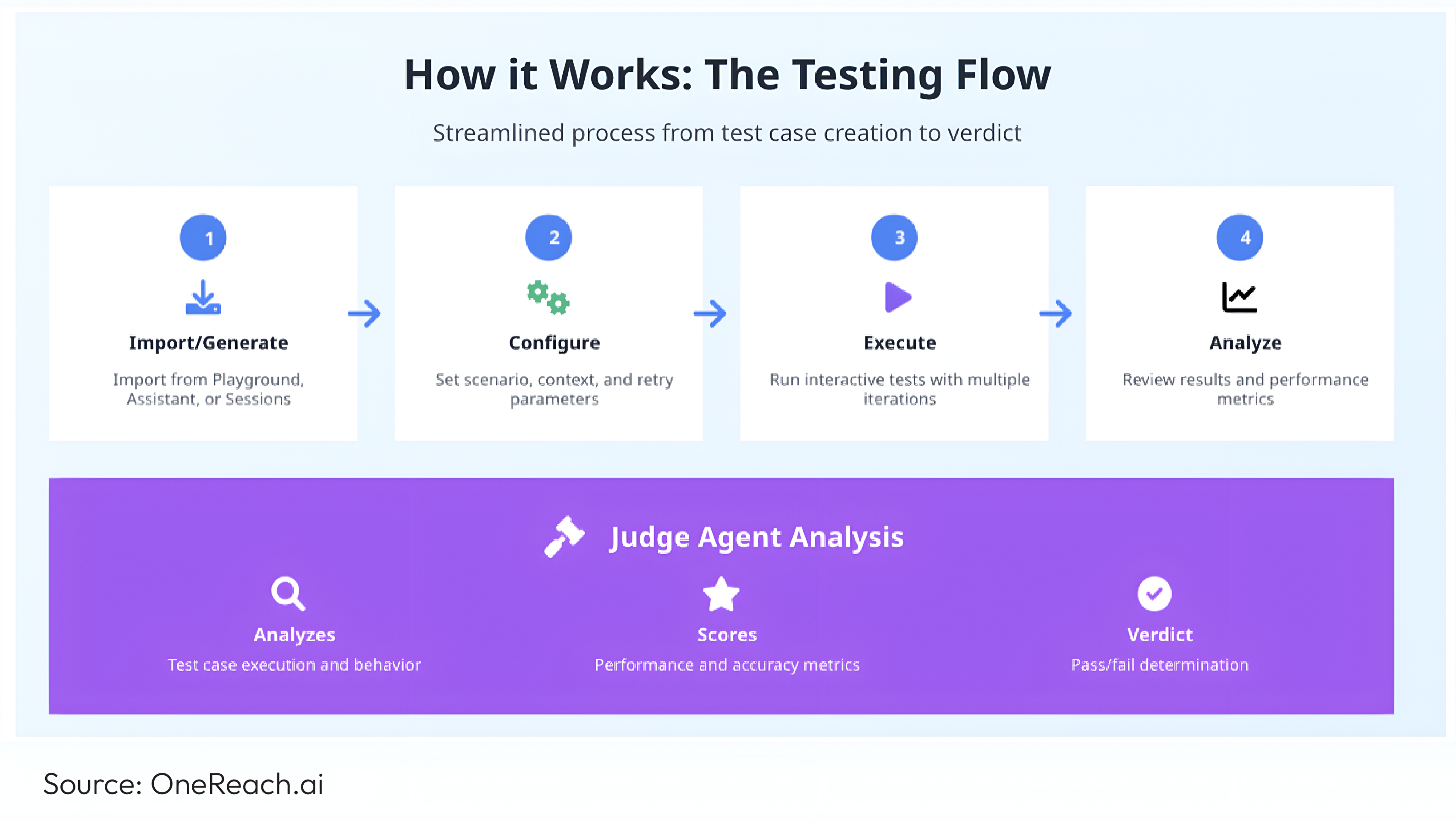
Gartner’s ADLC (agent development life cycle) framework specifies evaluation-driven development: scenario-based behavioral testing, LLM-as-a-judge scoring, statistical confidence thresholds, and error budgets typically set between 70% and 85% pass rates for nondeterministic components.
Figure 2: GSX AI Agent Testing Workflow
- Agent Deployment and Orchestration Phase
The deployment phase is when AI agents are validated for production and start creating business value. Production rollout, systems integration, user onboarding, and go-live support require an agent platform capable of managing complex deployment scenarios. Successful deployment ensures agents integrate seamlessly with existing IT systems, while maintaining performance and reliability.
Efficient deployment of AI requires a robust technical infrastructure consisting of secure and well-configured environments, automated Continuous Integration/Development (CI/CD) pipelines, and scalable containerization. Seamless integration with enterprise systems via pre-built or Application Programming Interface (API)-based connectors ensures real-time data flow across legacy and modern platforms.
User and operational readiness are equally important. Effective onboarding and change management facilitate adoption, and real-time monitoring during go-live enables tracking performance and resolving issues quickly while establishing trust and continuity.
For multi-agent environments, orchestration is where complexity compounds. Agents that call external tools dynamically, coordinate with other agents, and modify data across systems require a control plane that tracks every integration, every handoff, and every permission boundary.
- Agent Monitoring Phase
The monitoring process gives a continuous view of AI agent performance and behavior, as well as their business impact. Tracking performance, analyzing usage, detecting errors, and monitoring compliance require real-time observability tools equipped with AI-specific metrics and alerting capabilities. Continuous monitoring enables organizations to identify issues early, measure business outcomes, and achieve operational excellence.
Monitoring AI agents requires a combination of technical, behavioral, and business performance tracking. Performance metrics such as response time, uptime, task completion, and error rate help ensure agents satisfy service-level agreements (SLAs) and stay reliable. Behavioral monitoring involves understanding decision-making patterns, tool usage, and interaction flows to identify anomalies or model drift before any harm or improper changes occur.
Beyond performance, monitoring must show real business value and compliance. Usage analytics, including customer satisfaction, resolution rates, savings, and revenue impact, help assess the return on investment (ROI) and identify areas for improvement. In regulated environments, audit logs and compliance tracking ensure transparency and accountability.
- Agent Optimization Phase
The optimization stage enables ongoing improvement through performance tuning, retraining models, feature enhancement, and support for feedback loops. This includes establishing automated optimization pipelines and continuous learning mechanisms that help AI agents evolve and adapt to changing conditions, delivering increasing value over time.
The goal of optimizing AI agents is to improve speed, accuracy, and cost efficiency. By using performance data, organizations can identify bottlenecks, refine prompts, select models with optimal cost-performance ratios, and simplify agent reasoning. As products, policies, or user needs change, agents also need periodic retraining.
Ongoing enhancement depends on structured feedback, testing, and strong lifecycle control. Human-in-the-loop feedback and A/B testing help refine responses and interaction styles, while version control ensures secure updates with the option to roll back if needed. As agents mature and deliver results, organizations can scale them to handle higher workloads, expand to new use cases, integrate more tools, and extend adoption across different business functions, without compromising performance. This stage is crucial for sustaining AI automation over time, ensuring agents evolve rather than stagnate.
Decommissioning: Retiring Agents Responsibly
Agents eventually become obsolete as business needs evolve, technologies advance, or better approaches emerge. Retiring AI agents properly prevents security vulnerabilities and reduces operational complexity.
Knowing when to retire an agent isn’t always clear, which is why clear criteria matter. Low usage, declining performance, regulatory changes, or a shift in business priorities are all signs that it’s time to phase an agent out. These triggers should be defined from the start, not decided reactively. This way, retirement becomes a planned part of the lifecycle, not an ad-hoc scramble.
Retirement needs to be handled with the same discipline as launch. Access must be revoked, data archived or deleted as per policy, and configurations removed to avoid “ghost agents” with lingering system access. Finally, don’t lose the learnings; document the agent’s role, performance, wins, and challenges. This knowledge often holds insights that can sharpen future agent design rather than disappearing with the retired agent.
What an AI Agent Runtime Platform Governs
An AI agent runtime platform provides the infrastructure that makes lifecycle management possible at enterprise scale:
- Agent registry — every agent tracked with owner, purpose, version history, data scope, and risk posture.
- Evaluation infrastructure — automated, statistically rigorous testing across development and production.
- Observability — behavioral and business telemetry retained beyond an agent’s operational life.
- Orchestration — multi-agent coordination with defined handoff contracts and permission boundaries.
- Compliance-gated controls — structured checklists for deployment and retirement producing auditable records.
The enterprises that scale rather than cancel their AI programs are the ones that built this infrastructure before the first agent went live. Agents operate. Infrastructure governs. That distinction separates an AI strategy from an experiment.
OneReach.ai GSX Platform: Complete Agent Lifecycle Management and Orchestration at Scale
OneReach.ai’s Generative Studio X (GSX) Agent Platform provides comprehensive Agent Lifecycle Management capabilities that support enterprises throughout all six stages. As a comprehensive Agent Platform, GSX enables organizations to design, train, test, deploy, monitor, and optimize AI agents at scale while providing advanced multi-agent orchestration capabilities.
Beyond individual agent lifecycle management, GSX enables advanced multi-agent orchestration that coordinates multiple specialized agents working toward shared business outcomes. The platform’s composable architecture with over 1,500 pre-built components and integration with the Model Context Protocol (MCP) enables agents to dynamically discover capabilities, share resources, and coordinate complex multi-step workflows and processes.
Manage Agent Lifecycle for Lasting Competitive Advantage
The six stages of the agent lifecycle management provide a structured framework for organizations looking to transform AI agents from experimental prototypes into strategic assets that deliver measurable, sustainable value.
Organizations that invest in full agent lifecycle management see strong results. In the first year alone, Return on Investment (ROI) often climbs to 3–6x, with 85–90% lower costs than human-only operations. Over time, as agents learn and improve, returns can grow to 8–12x and governance becomes far stronger. These results show that lifecycle management is not merely a technical or IT discipline but a strategic enabler of business transformation.
Scaling AI agents brings its own challenges, including coordinating distributed systems, ensuring data quality, testing for non-deterministic behavior, and maintaining proper oversight. But with the right foundations and tools, these become manageable and avoidable. Modern Agent Platforms provide the structure and control needed to govern the full lifecycle effectively. OneReach.ai’s GSX Platform brings this together with orchestration and lifecycle management, backed by the security, governance, and compliance enterprises rely on.
Why Agentic AI Projects Fail, and What Governs the Ones That Don’t
Learn MoreFAQs
1. What is an AI agent runtime platform?
An AI agent runtime platform is the infrastructure layer that designs, deploys, monitors, orchestrates, and retires AI agents within a single governed system. It covers the full operational lifecycle — including behavioral evaluation, multi-agent coordination, observability, compliance controls, and decommissioning protocols. It is distinct from agent-building tools, which only address the development step.
2. What is the strategic value of agent lifecycle management for enterprises?
Agent lifecycle management ensures AI agents don’t remain small pilots but evolve into scalable, high-impact assets. It creates a repeatable framework for governance, performance, and accountability, enabling enterprises to scale AI responsibly across functions. Leaders gain confidence that agents can be expanded without increasing operational risk, compliance exposure, or cost unpredictability, turning AI agents into a long-term strategic capability, not a one-off initiative.
3. How does an agent platform support complete agent lifecycle management?
An agent platform provides integrated tools for each stage of the AI agent lifecycle: design, training, testing, deployment, monitoring, optimization, and decommissioning. By centralizing these capabilities, platforms like GSX enable secure onboarding, reliable versioning, automated testing, real-time monitoring, and compliant retirement, reducing complexity while improving collaboration, governance, and business outcomes. This unified approach helps organizations launch and manage agents confidently, adapt quickly, and maintain visibility and control as agents scale in production.