
Key Takeaways:
- Most agentic AI project failures are not technology failures, they are governance and operating model failures.
- The three dominant failure patterns are scope creep, missing guardrails, and unmanaged AI agent sprawl.
- Scaling agentic AI requires a control plane with lifecycle management, policy enforcement, and measurable service-level objectives.
Gartner projects that over 40% of agentic AI projects will be canceled by the end of 2027, due to escalating costs, unclear business value or inadequate risk controls. Why is the agentic AI project that impressed every stakeholder in the demo a few months later still sitting in a staging environment? The model works. The integrations technically run. The agents can do the things. And yet nobody can sign off on putting it in front of customers. Postmortems point to the LLM. But the LLM is rarely the problem.
What is the problem? Gartner forecasts that the average Fortune 500 enterprise will have over 150,000 AI agents in use by 2028, up from fewer than 15 in 2025, while only 13% of organizations report having the right AI agent governance in place. Capability is racing ahead of the operating model around it. That is what most failed agentic AI projects have in common. They are not technology failures. They are governance failures wearing a technology disguise.
What Is the AI Project Failure Rate in 2026?
The AI project failure rate is not best measured by cancellation alone. It is measured by the space between deployment and dependable operation. In January 2026, Gartner predicted that more than 60% of early agentic orchestration implementations will fail to meet performance or cost expectations by 2030, because enterprises will underestimate the integration, governance, and talent required to make digital workforces reliable at scale. For anyone leading an agentic AI project, that is the operating gap to plan against.
Why Do AI Projects Fail When the Agents Themselves Work?
They fail in the operating environment around the model: the absence of agent lifecycle management, the lack of AI agent orchestration across systems, and the missing evaluation layer that would tell anyone in production whether the agent is still performing within acceptable bounds.
Figure 1: Why Do Agentic AI Projects Fail?
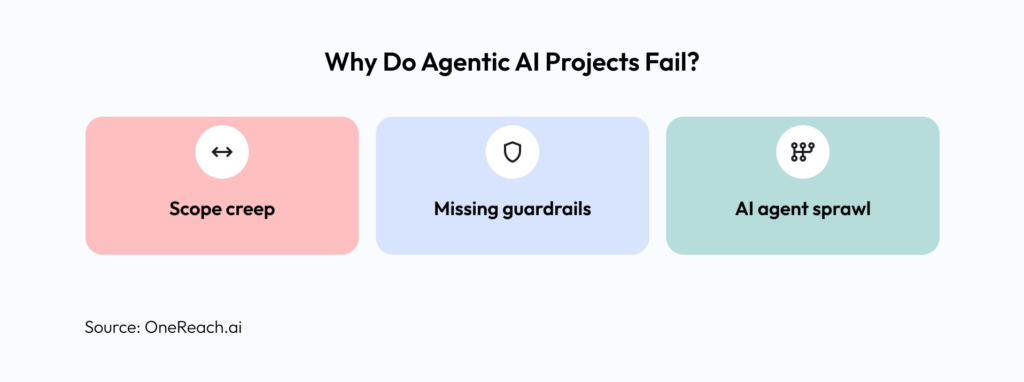
Three patterns repeat across postmortems:
- Scope creep. LLM-based agents perform unevenly across tasks that look similar in difficulty. Reliability improves only when the scope is narrowed to the center of what the agent can do consistently, and expanded one experiment at a time as the data supports it. Agents launched with a broad scope almost always fail in places nobody saw coming.
A common version of this: a customer service agent deployed to handle billing, returns, and general inquiries. This includes three distinct task types with different data dependencies. When performance on the billing portion is adequate but poor on returns and general inquiries, there is no mechanism to detect or contain the degradation. - Missing guardrails. An agent without automated input, output, and resource-call guardrails is not more autonomous. It is more supervised, because a human has to check every action it takes. That overhead either kills the business case or degrades into rubber-stamping.
In practice, this often shows up six to eight weeks post-deployment, when the review queue has grown large enough that approvers are stamping actions without reading them. At this point, the governance model has already failed. - Unmanaged AI agent sprawl. Gartner describes the shape of the risk: tens of thousands of agents per enterprise within two years, very few of them under governed observation. Easy deployment without coordination produces shadow AI: agents acting on behalf of the enterprise that nobody can audit.
The audit problem becomes acute when regulators ask for a record of decisions made by automated systems. An enterprise that cannot produce that record for agents it has deployed is in a materially worse position than one that deployed no agents at all.
From Experimentation to Industrialization
The first phase of enterprise agentic AI answered whether agents could be built. That question is closed. The current phase, where agentic AI is becoming critical infrastructure, asks whether agents can be operated. Organizations are already funding AI/agent security and governance at 16.7% of planned AI investment on average, according to IDC.
Industrialization implies a different infrastructure than experimentation. A pilot can tolerate a custom prompt, a single integration, and a developer watching the logs. A program of fifty agents across CRM, ERP, and customer channels cannot. It needs a control plane that registers each agent, propagates identity and policy across hops, retains context between interactions, captures lineage for audit, and measures performance against a defined service level.
What Governs the Agentic AI Projects That Succeed
The agentic AI projects that move from demo to production share a consistent governance pattern. Reliability targets are defined before deployment, expressed as service-level objectives and error budgets. Autonomy is earned against measured performance, not granted on faith. Every agent is registered against a known scope, and that scope expands only when the data supports it. Forrester describes this maturity shift directly, claiming that agentic AI is no longer defined by chat-based interactions or experimental prototypes, but by its ability to execute work reliably across enterprise environments.
In practice, that governance pattern starts with three decisions made before a single agent reaches production:
- Define the service-level objective in plain terms: what task completion rate, latency, and error threshold is acceptable, and what triggers a human escalation.
- Establish a registry entry for each agent that records its scope, data access, permitted tool calls, and the identity of the person accountable for its behaviour.
- Set an explicit threshold for earned autonomy. This defines the measured performance level at which a human review step can be removed, and the conditions under which it is reinstated. Organizations that make these decisions in advance have a governance model. Organizations that make them reactively, after something goes wrong, are writing a postmortem.
That is the practical answer to why AI projects fail. The pilot proved that an agent could act. The program needs agentic AI infrastructure that proves every agent in the system is acting with authority and within recoverable boundaries.
Why Enterprises Need an AI Control Plane for Agentic Systems
Learn MoreFAQs
1. Why do agentic AI projects fail even when the model works?
Because failure usually happens outside the model in missing governance, unclear scope boundaries, and a lack of production-grade guardrails and monitoring.
2. What are the biggest risks in scaling AI agents in enterprises?
The risks that organizations consistently underestimate are regulatory exposure from unaudited agent decisions, the cost of manual oversight when governance mechanisms and guardrails are missing, and the compounding difficulty of retrofitting governance onto agents that were deployed without it. Governance architecture is significantly harder to add after deployment than before it. The earlier it is designed into the program, the lower the remediation cost.
3. What is required to successfully move agentic AI from pilot to production?
Beyond the technical infrastructure, the move from pilot to production requires two organizational decisions that are often skipped: who is accountable for each agent’s behavior (a named person, not a team), and what the escalation path is when an agent acts outside its expected boundaries. Without those decisions made in advance, the control plane has nowhere to route exceptions, and the governance model breaks down at the first edge case.