
Key Takeaways:
- AI agent washing is rebranding chatbots, scripted workflows, and NLQ tools with an agentic label.
- To cut through the hype, it’s important to understand what a “real agent” is and evaluate vendors accordingly.
- Governance and observability determine whether an agent is suitable for enterprise environments.
Right now, the market is full of products labeled as “AI agents” that aren’t really agents at all. They are chatbots, scripted workflows, and basic natural language query (NLQ) tools wearing an ironed-on label. This practice is known as “AI agent washing.” It’s widespread and is becoming more sophisticated as technology companies and services companies race to keep up with the hype and their competition.
Although agentic AI is real (enterprises are running agents in production, and a credible set of vendors is building the capabilities behind them), 37% of respondents in the 2025 Gartner Peer Community Poll believe truly usable AI agents remain a distant reality.
Despite this, the volume of conversations about agentic analytics has surged by nearly 2,500% since the start of 2024 to the end of June 2025, based on a Gartner analysis of social media listening data. Gartner also projects that by 2028, 70% of technology providers in every software market will offer AI agents, up from roughly 10% today. For CIOs and CPOs, that means the vendor landscape will look agentic long before most of it is. The procurement question is no longer whether a vendor has agents. It is whether what they are selling is genuine agentic AI or a rebranded solution.
OneReach.ai builds an agentic orchestration platform and has a commercial interest in this conversation. We apply the same evaluation criteria below to our own GSX platform agents.
What Is AI Agent Washing?
Figure 1: AI Agent Washing
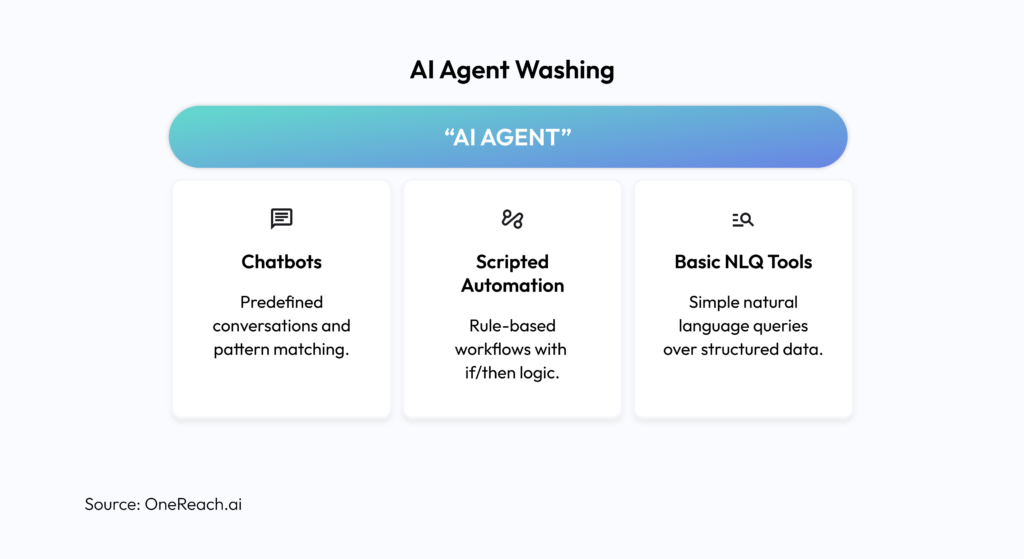
Agent washing occurs when vendors bolt AI capabilities onto existing products such as chatbots, scripted automation, or basic natural language query tools, and rebrand them as “AI agents.” Often, nothing changes beneath the label. There is no new architecture and no real autonomy, only a relabeling of existing functionality to chase what the market is asking for.
Gartner defines it as “the labeling of basic AI or GenAI features like chatbots or assistants as AI agents with the aim of creating marketing hype and driving product sales interest.” The practice is increasingly common across automation, integration, and enterprise software vendors. Legacy features are repositioned as agentic capabilities without new engineering behind them.
The result is a trust problem. Enterprises buy products marketed as autonomous AI agents, but encounter the familiar challenges of previous generations of automation or unrefined applications of LLM usage. Confidence erodes and the doubt does not stay with one vendor. Buyers question the credibility of AI agents altogether.
Three Patterns of AI Agent Washing
- A chat interface is not an agent. A chat overlay on top of static queries or scheduled reports is a conversational wrapper. It often runs on deterministic logic, fixed workflows, or AI models that return predefined outputs. A genuine agent is built on generative AI: it interprets intent, plans across steps, calls tools, observes results, and adapts, rather than following a pre-programmed decision tree. If a vendor cannot demonstrate that multi-step behavior on your own data, you are looking at a chat facade.
- Rule-based workflows are not cognitive. Vendors sometimes describe deterministic automation (if/then logic, predefined decision trees) as “cognitive workflows” or “intelligent automation.” These are valuable tools, but they aren’t agents. A real agentic system handles dynamic environments, recovers from unexpected states, and pursues goals rather than executing scripts.
- NLQ-to-SQL is not intelligence. Translating a natural language question into a database query is a useful functionality. But if that is where the chain ends (no hypothesis testing, no proactive recommendations, no multi-turn context), calling it an analytics agent stretches the term past recognition. Gartner specifically flags this pattern as a common agent washing tactic.
Figure 2: Three Patterns of Agent Washing

Why This Matters Financially, Not Just Technically
The financial exposure from agent washing goes beyond a bad purchase. It compounds.
Gartner’s Agentic AI: Unmask the Cost and Licensing Impact on SaaS Negotiations report projects that through 2029, 60% of AI-engaged organizations will face unforeseen cost overruns due to opaque vendor pricing. The mechanism is structural: agentic systems use consumption-based models measured in tokens, credits, or “AI units.” None of which are standardized across vendors.
These costs are also difficult for organizations to predict and control. Usage can scale rapidly as agents perform more tasks, invoke more models, or process larger volumes of data, leading to unexpected overages once consumption thresholds are exceeded. In many cases, vendors themselves are passing through the underlying costs they incur from model and infrastructure providers, which means the financial burden ultimately falls on the organization deploying the agentic system.
For example, a financial services firm deploys an AI agent from a major enterprise suite vendor to handle compliance document review. The agent turns out to be a sophisticated search tool with a conversational layer. It’s useful, but not autonomous. When the firm attempts to connect it to adjacent workflows, there is no orchestration layer, no cross-system telemetry, and no governance framework that travels with the agent outside the vendor’s own ecosystem. They have bought a point solution wearing an agent’s clothing.
How to Navigate Past the Agentic Hype
The buyer’s real position is countless vendors and near-identical claims. A practical posture handles it.
- Demand a proof of concept. Specifically, ask the vendor to: (1) show a full reasoning trace: what the agent planned, what tools it called, and where it changed course; (2) introduce an unexpected input mid-task and describe how the agent responded; (3) demonstrate what happens at a governance boundary: who gets notified, what gets logged, and how a decision gets escalated or reversed.
- Match the task to the right tool type before you evaluate vendors. Two questions do most of the work: Does the job require handling inputs the system has never seen before? And does the right answer change depending on context that isn’t fully specified in advance? If both answers are yes, you need genuine agentic capability with probabilistic reasoning, tool use, and adaptive replanning. If either answer is no, a scripted workflow or NLQ tool will be faster, cheaper, and easier to govern. Establishing this before vendor conversations helps prevent the most common procurement mistake: buying an agent for a job that doesn’t need one.
- Read consumption pricing as a cost model, not a footnote. If the product is a genuine agent, its cost scales nonlinearly with usage. More tasks mean more tool calls, more model invocations, and more tokens. Before signing, ask the vendor for three numbers: cost per completed task at your expected volume, the cap or escalation threshold above which pricing changes, and what a 2× usage spike would cost. If they can’t answer all three, you don’t have enough information to forecast the contract. Build those numbers into the business case alongside the expected value of the automated task.
The vendors worth your time will show you a real agent working on your data and will tell you honestly when your job doesn’t need one. Transparency about capability and transparency about fit are two behaviors that provide the fastest signals available. The hype cycle makes both rare. That’s precisely what makes them reliable filters.
The Procurement Posture That Works
The procurement question has shifted. In 2024 it was “does this vendor have agents?” That question is now obsolete. Every enterprise software vendor will claim yes by the time you read this. The question that separates genuine capability from label is: what happens when those agents interact with each other, with your other systems, and with data they weren’t explicitly designed to handle?
Vendors who can answer that question with architectural specificity, not feature lists, are worth evaluating. Vendors who can’t are describing a destination, not providing you the means to get there.
Why Agentic AI Projects Fail, and What Governs the Ones That Don’t
Learn MoreFAQs
1. What is AI agent washing?
Agent washing is the practice of rebranding existing software (chatbots, robotic process automation, basic natural language query tools) as “AI agents” without introducing genuine autonomous capability.
2. How do I know if a vendor is agent washing?
Ask for a live demonstration on your data, not a scripted demo. Request an auditable trace of the agent’s reasoning: what it planned, what tools it called, what it changed when conditions shifted. If the vendor cannot produce a multistep reasoning trace, or if “autonomous” turns out to mean “executes a predefined workflow,” you are likely looking at a rebranded automation.
3. What should CIOs prioritize when evaluating AI agent platforms?
Three things: governance architecture, orchestration depth, and telemetry. Governance should be structural, not a feature bolted onto a single application. Orchestration should work across vendors, models, and cloud environments. Telemetry should give the CIO full visibility into what every deployed agent is doing and on whose authority. Platforms that can demonstrate all three without requiring lock-in to a single ecosystem are the ones worth serious evaluation.