A multi-agent system (MAS) is a coordinated group of AI agents, each with its own role, tools, and decision-making authority. Together, they work to complete tasks that are too complex for any single agent to handle. Instead of one model trying to do everything, specialized agents divide the work, exchange information, and combine their outputs into a final result.
MAS is moving quickly from hype and curiosity toward usable enterprise design patterns. Gartner reports that client inquiries on MAS jumped 1,445% between Q1 2024 and Q2 2025, and the design choices behind these systems have real consequences for reliability, cost, and governance. One really important dimension for multi-agent system design is the orchestration pattern used: how do the agents coordinate?
Drawing on recent work from Google DeepMind and Gartner, four orchestration patterns are emerging as dominant designs. They sit on a spectrum from rigid and predictable to fluid and emergent, and each has different strengths, trade-offs, and ideal use cases.
Multi-Agent Coordination Patterns
In a recent Gartner report, the firm has identified three primary ways agents coordinate within a MAS, each with distinct governance and oversight implications. In a recent study by Google Research, the authors evaluated four multi-agent coordination patterns. Throughout this blog post, Google DeepMind MAS definitions and terminology will be used.
Their definitions and coordination styles are listed below:
| Coordination Pattern | Google DeepMind Definition | Gartner Definition |
| Centralized MAS | An orchestrator assigns subtasks, reviews outputs, and re-runs rounds as needed. Sub-agents work in parallel; all comms route through the orchestrator. | A central orchestrator agent decomposes goals and delegates subtasks to specialist agents. Clear chain of command; highest level of oversight and control. |
| Independent MAS | Sub-agents work the same task in parallel, and then outputs are merged. No comparison, debate, or review. | No equivalent |
| Decentralized MAS | Agents talk peer-to-peer, sharing reasoning, challenging each other, refining across rounds. Consensus emerges from the conversation. | Agents negotiate, share information, and self-organize to complete tasks. Minimal central control; emergent problem-solving. |
| Hybrid MAS | An orchestrator coordinates the workflow, but agents can also communicate directly. Vertical control and lateral collaboration. | Agents collaborate within defined boundaries; a coordinator structures without micro-managing. |
Centralized MAS — the orchestrator and specialists model
Figure 1: Centralized MAS
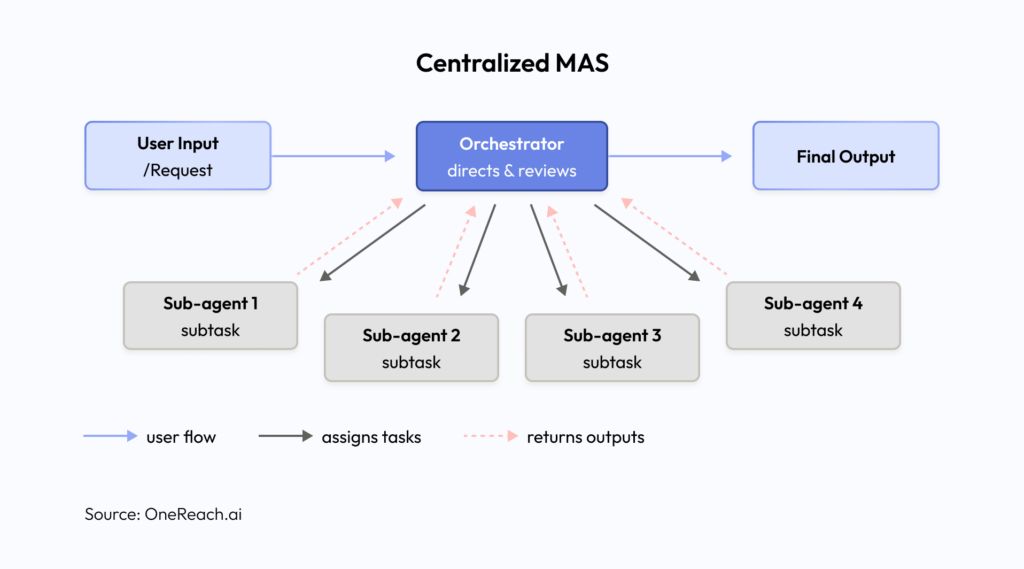
A single orchestrator agent owns the workflow. It decomposes the goal, assigns subtasks to specialist sub-agents, reviews the results, and runs additional rounds until the result is acceptable. Sub-agents work in parallel but never communicate directly. All communication passes through the orchestrator.
Good for: complex workflows that decompose cleanly into independent parts, and any environment where oversight, auditability, and a clear chain of command matter: regulated processes, customer-facing automation, anything where you need to know exactly which agent did what.
Independent MAS — parallel, no cross-talk
Figure 2: Independent MAS
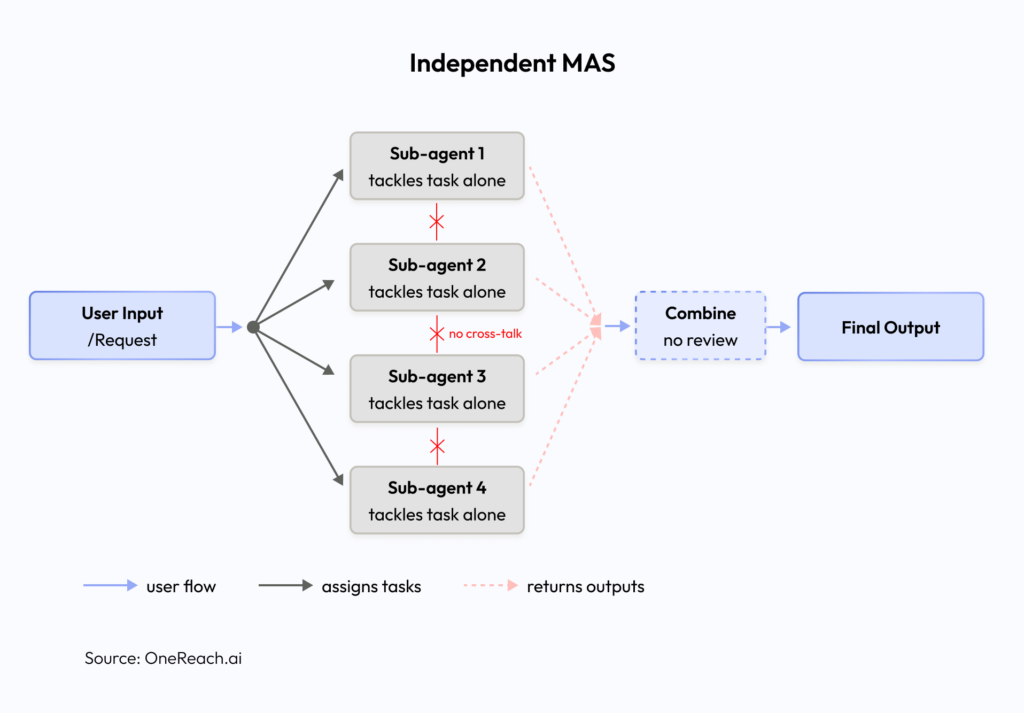
Sub-agents are launched in parallel to the same task and tackle it independently. Their outputs are collected and combined at the end, but never compared, debated, or cross-checked. There is no orchestrator review and no consensus mechanism.
Good for: information gathering, brainstorming, and many tries, pick the best generation tasks where diversity of output is valuable. It’s the cheapest pattern to run and the easiest to parallelize, but it provides no built-in quality control.
Decentralized MAS — peer-to-peer reasoning
Figure 3: Decentralized MAS
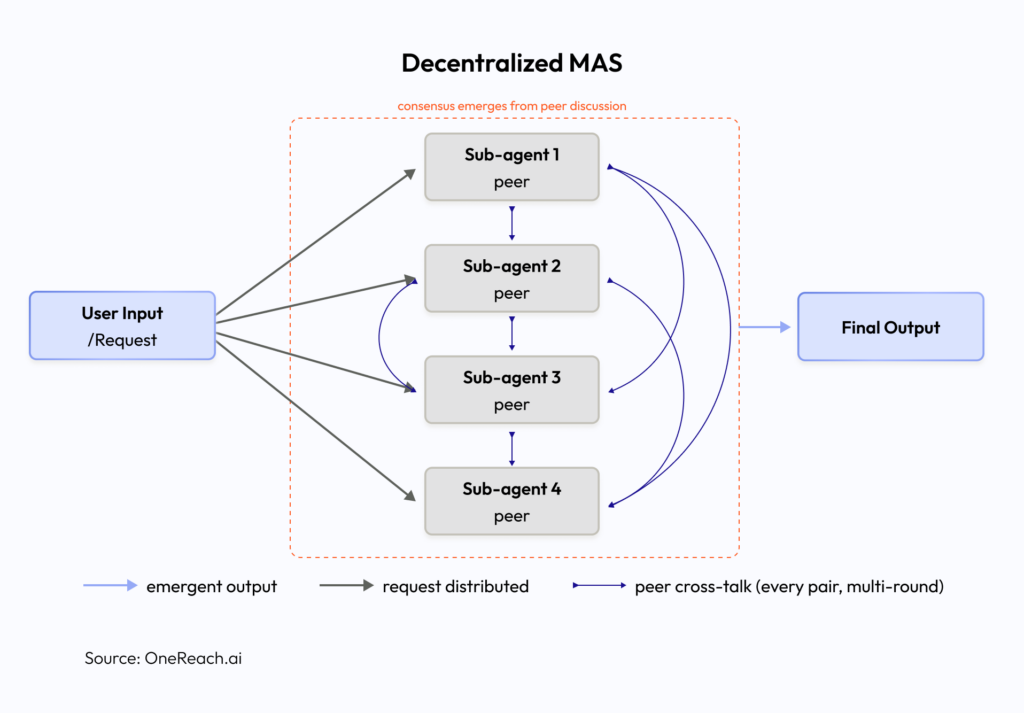
Agents work the problem together. Rather than reporting up to a central authority, they communicate directly with one another, share reasoning, challenge each other’s outputs, and refine their conclusions across multiple rounds of peer discussion. Consensus emerges from the conversation itself.
Good for: open-ended reasoning where there is no single correct answer to verify against (e.g., strategy work, design exploration, scientific hypothesis generation, complex judgment calls).
Trade-off: high flexibility but lower reliability, and the conversation can drift without a critic. Use when you want exploratory problem-solving, not predictable execution.
Hybrid MAS — vertical control plus lateral collaboration
Figure 4: Hybrid MAS
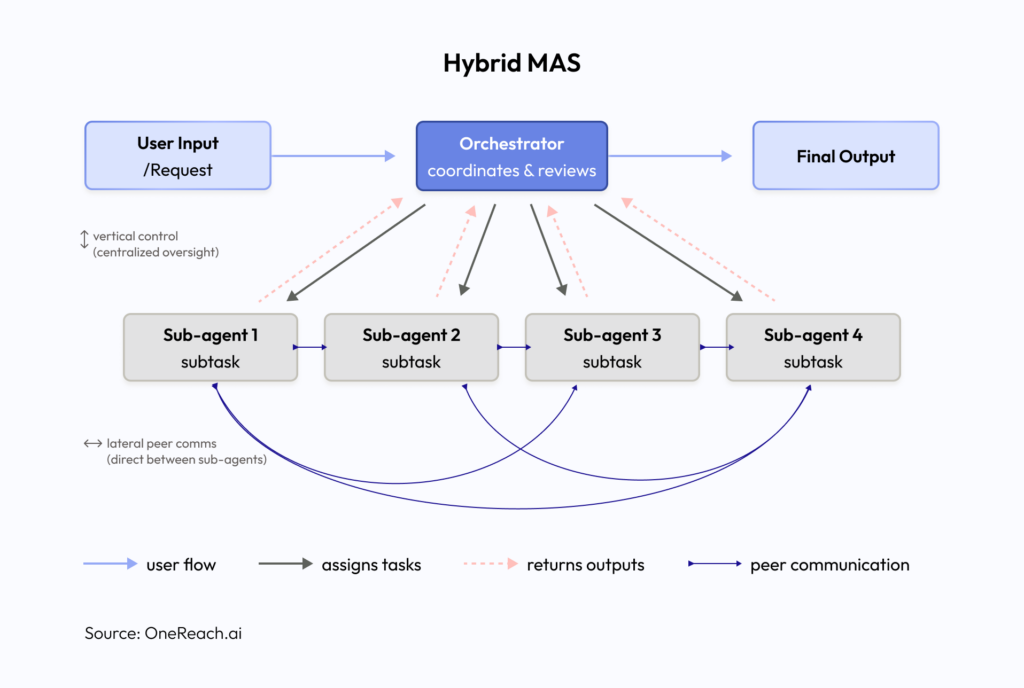
A hybrid combines the structure of a centralized orchestrator with the flexibility of peer communication. The orchestrator still coordinates the overall workflow, but sub-agents can also communicate directly between orchestration rounds. Control flows both vertically (orchestrator to agents) and laterally (agent to agent).
Good for: complex enterprise workflows that need governance and genuine collaboration; for example, a research-and-recommendation pipeline where specialists need to compare notes throughout the process, or a customer escalation flow where domain agents must coordinate before the orchestrator commits to a response.
This is increasingly the default for production MAS because it preserves auditability without forcing every interaction through a bottleneck.
Why Pattern Selection Matters: Cost, Cascading Errors, and Governance
Choosing an orchestration pattern directly determines two things critical to any AI deployment: how much the system costs to run and how badly it fails when something goes wrong.
- Token costs compound with coordination. Every additional agent, every extra round of peer discussion, every orchestrator review is another LLM call. A poorly designed MAS produces high and unpredictable costs, and token-based pricing means costs scale with usage rather than value.
- Cascading errors compound with autonomy. In any multi-step system, a small upstream mistake can propagate, amplify, and become an unrecoverable downstream failure. Without robust error handling, rollback mechanisms, and a critic agent or human-in-the-loop checkpoint, a decentralized MAS can confidently deliver a wrong answer that goes unquestioned.
Solid architecture and governance are the antidote. The patterns themselves don’t prevent runaway cost or cascading failure; the architecture around them does. That means: minimizing each agent’s agency to only what its task requires, instrumenting agent-to-agent communication so you can observe and audit it, putting guardrails and critic agents at the points where errors would be most expensive, and matching the pattern to the shape of the problem rather than reaching for the most autonomous design available.
Most likely, your organization will have dozens of problems for agentic AI that require different orchestration patterns. Retaining flexibility and governance throughout any orchestration pattern is key. The pattern is the starting point. The governance and architecture you wrap around it are what make it work.
MAS Strategy: Prioritize Governance and Flexibility
The four patterns give enterprise teams a shared vocabulary and smarter design thinking for multi-agent systems. The mistake is treating orchestration as a one-time architectural choice rather than a per-workflow design decision.
Whichever you choose, the pattern is only the starting point. The guardrails, observability, and critic agents you build around it determine whether your MAS scales reliably or quietly compounds costs and errors.
Ready to design a multi-agent system?
Connect with UsFAQs
- What is a multi-agent system (MAS)?
A multi-agent system is a group of specialized AI agents that work together to complete tasks too complex for a single agent. Each agent has its own role, tools, and decision-making authority, and the system’s behavior emerges from how those agents coordinate, communicate, and combine their outputs.
- Which MAS orchestration pattern is best for enterprise use?
There’s no universal best pattern. The right choice depends on the workflow. Centralized MAS works well for regulated processes where auditability matters. Hybrid MAS is increasingly the default for production enterprise workflows because it balances oversight with collaboration. Decentralized MAS suits open-ended reasoning. Independent MAS is best for low-stakes parallel generation. Most enterprises will end up running several patterns side by side.
- How is multi-agent orchestration different from traditional workflow automation?
Traditional automation follows a fixed, deterministic script: step A triggers step B. Multi-agent orchestration is dynamic. Agents interpret intent, decompose tasks, choose tools, and adapt their approach based on intermediate results. This flexibility is the value proposition, but it’s also why governance, observability, and pattern selection matter more than they do in rule-based automation.
- What are the biggest risks of deploying a multi-agent system?
The two largest risks are runaway token costs and cascading errors. Coordination is expensive; every agent call, peer exchange, and orchestrator review consumes tokens. Small upstream mistakes can amplify into large downstream failures without critic agents or human-in-the-loop checkpoints. Governance, observability, and minimizing each agent’s agency to only what its task requires are the most reliable safeguards.
- Can an enterprise use more than one orchestration pattern at once?
Yes, and most will. Different problems call for different coordination styles, so that a single enterprise might run a Centralized MAS for compliance-sensitive workflows, a Hybrid MAS for cross-functional research, and an Independent MAS for content generation. The key is to maintain consistent governance, observability, and architectural standards across patterns rather than standardizing on a single pattern.