Key Takeaways:
- Retiring AI agents is difficult because they accumulate context, decisions, and dependencies over time, so decommissioning requires unwinding software and the operational and data footprint they have built across systems.
- Safe retirement must account for everything the agent has touched, including data, integrations, downstream processes, and regulatory obligations, since these persist even after the agent is turned off.
- Auditable retirement depends on governance infrastructure defined before deployment, such as an agent registry, persistent telemetry, and formal retirement procedures, so that shutdowns remain traceable and compliant.
By 2030, 90% of actively used AI agents developed by enterprises or vendors before 2028 will need to be rebuilt due to rapid changes, much like the early years of mobile app development, according to Gartner. Retiring an AI agent is a governance event that carries the same operational weight as deploying one. By the time you go to shut an agent down, it’s holding accumulated context, live integrations, and a decision history that other systems and people have come to rely on. Turn it off without accounting for all that, and you’re left with compliance and operational gaps.
Many organizations have a plan for deployment of AI agents. Far fewer have a plan for what happens when those agents need to be retired. That is the gap we want to talk about in this article, and it’s worth closing before you’re the one pulling the plug.
What Makes AI Agent Retirement Different?
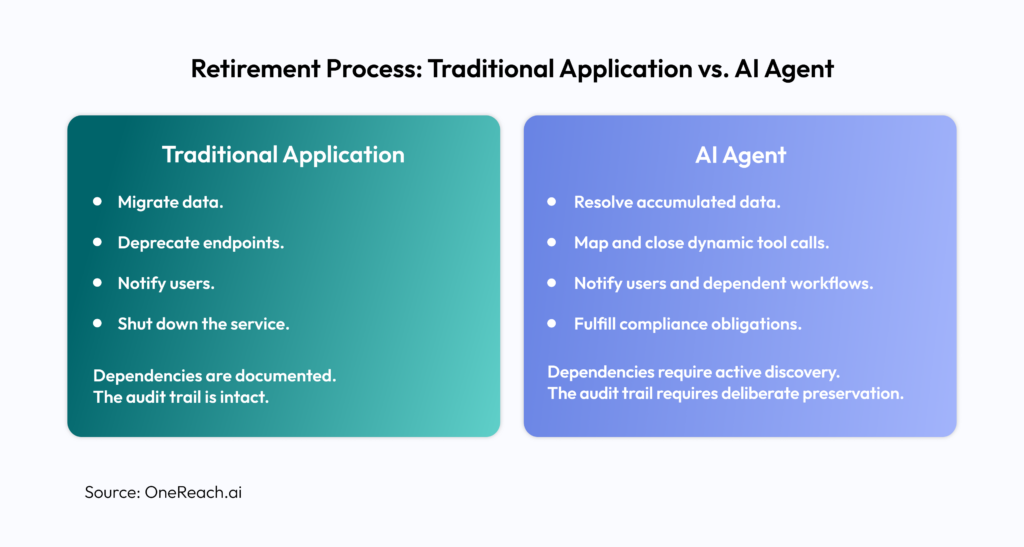
Figure 1: Retirement Process: Traditional Application vs. AI Agent
Picture two retirements inside the same enterprise.
The first is a legacy customer-service chatbot. It followed scripted decision trees, wrote nothing back to systems of record, and logged every interaction to a known database. Decommissioning the chatbot is bounded work: redirect the traffic, archive the logs that already exist, and close the service. The dependencies were documented because the system never changed on its own.
The second is the AI agent that replaced it. Over twelve months, it built a memory of customer interactions, called three internal APIs to resolve issues, wrote summaries back to the CRM, and learned which resolutions customers accepted. Customers came to rely on how it behaved. When the team retires it, none of that lives in one place, because the agent generated its own context as it ran.
Some agents are genuinely easy to retire. A stateless agent that only reads data and writes nothing back can be shut down as cleanly as the old chatbot. However, the agents that create exposure are the ones that hold state, act on it, and write to systems other teams depend on. Those also tend to be the agents an enterprise deployed first, because they delivered the most value.
An AI agent does more than consume data. It accumulates data, builds context through memory, calls external tools, and earns user trust through consistent behavior over time. Retire it without resolving those dimensions, and you’re left with orphaned data, a broken toolchain, a confused user base, and an audit trail that stops mid-record.
The compliance exposure is concrete. An agent that handles customer data under GDPR or HIPAA doesn’t shed those obligations when it’s switched off. The data it processed and routed still has to be accounted for. If its retention profile was never documented, the people who own the program are accountable for a gap they may not know exists.
Gartner’s Hype Cycle for Agentic AI report confirms that governance, security, and cost-control disciplines are becoming critical early in the adoption cycle, not after deployment at scale. Enterprises accumulate agentic risk faster than governance infrastructure to match it.
Ungoverned AI Agent Retirement Risks
Enthusiasm is running well ahead of operations, which is why this risk stays out of sight. Gartner’s survey shows that only 16% of IT leader respondents said they had agents in production, while 46% agreed that AI agents will replace many of their enterprise applications within two to four years. Agents are showing up faster than the discipline to govern their whole lifecycle, and an ungoverned retirement is where that gap turns into a liability.
Consider the most common failure. When a regulator or auditor asks for a complete record of automated decisions over the past eighteen months, the logs from a retired agent are often gone. In many cases, they were never written anywhere durable in the first place. An agent emits telemetry while it runs: which tools it called, which records it touched, which choices it made. By default, much of that lives only inside the agent’s own runtime, so when the container stops, the record stops with it. The auditor doesn’t care whether the gap was an oversight or a design choice. Either way, the record can’t be produced.
Figure 2: Ungoverned AI Agent Retirement Risks
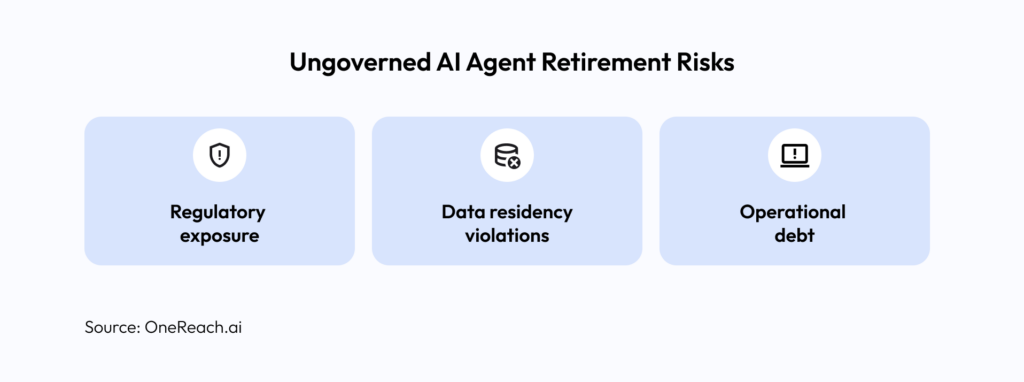
The risks compound across three dimensions:
- Regulatory exposure. Decision records that don’t survive decommissioning can’t answer an audit or a lawsuit, no matter how complete the new agent’s logs are.
- Data residency violations. Customer data handled under GDPR and similar rules comes with retention and deletion obligations, and an informal retirement just leaves those hanging.
- Operational debt. Systems that leaned on the agent keep calling an endpoint that no longer answers, quietly breaking processes nobody ever connected back to the agent you retired.
The Capabilities You Need to Retire Agents in the Future
Auditable retirement requires infrastructure that exists before the agent is deployed. An AI agent platform that governs deployment must govern retirement with equal rigor. The following four properties make that possible:
- An agent registry. Every agent in production must be registered with its owner, purpose, version history, data access scope, and risk posture. Without a registry, retirement becomes archaeology. Teams manually tracing what an agent touched and what it was authorized to access. Gartner recommends registry entries be detailed enough to determine an agent’s purpose and utility without additional investigation.
- Telemetry persistence. Operational records (what the agent did, what tools it called, what decisions it made) must be retained beyond the agent’s operational life. An audit request doesn’t expire when the agent does. Telemetry that is deleted or left unarchived at retirement is telemetry that can’t be produced under legal or regulatory scrutiny.
- Data handling profiles. Every agent should carry a documented record of what data it accessed, where it was stored, how long it was retained, and what happened to it during processing. This is the document that satisfies a regulatory inquiry, a data subject access request, or an internal compliance review.
- Compliance-gated retirement checklists. Retirement shouldn’t proceed without a structured checklist that mirrors deployment rigor: data scrubbing confirmed, dependencies notified, registry updated, telemetry archived, and user communications sent. The checklist is both a procedural safeguard and an auditable artifact that demonstrates the organization acted with governance.
What Is Enterprise AI Governance?
Learn MoreBest Practices for AI Agent Retirement
Retirement done well is a program-level discipline built into AI lifecycle management from day one.
- Assign a retirement owner at deployment. Every agent that goes into production should have a named owner responsible for its eventual decommissioning, including the data, dependencies, and communications that retirement involves. This owner must understand applicable compliance and data retention requirements and ensure Legal and Compliance teams are explicitly involved when the agent has processed sensitive data such as PII, PHI, or company IP. In enterprises, the owner is typically the product or platform team that deployed the agent, working with Legal and Compliance teams on regulatory obligations, and with the IT or platform engineering team on the technical teardown.
- Set a review cadence. Apart from the always-on observability the platform runs, put each agent through a recurring human review on a defined schedule. The review should assess whether the agent still meets its original objectives, whether its accuracy and error rate stay within an acceptable budget, and whether its data access permissions remain proportionate to the job. Gartner notes ongoing supervision as a core stage of the agent development lifecycle. Continuous monitoring catches drift in real time. The scheduled review is where a person decides whether an agent should be improved, scoped down, or retired.
- Treat dependency mapping as a live document. Agent integrations change constantly: tools get added, APIs get versioned, and downstream processes evolve. A dependency map that was accurate at deployment but never updated will fail at retirement, so the platform should keep it current. In practice, it should read like an operational fact you can pull up on demand. For an agent, it might read: this agent has completed 1.5 million actions in 2025 and currently interacts with Oracle, Salesforce, and Workday. With that in view, the team can see exactly what will break before anything is switched off.
- Stage the retirement, and treat it as two tracks. Technical retirement is the engineering shutdown: inbound triggers, endpoints, credentials, the registry entry. Governance retirement is the audit and compliance close-out: confirming the agent’s actions are accounted for, its data is handled according to policy, and the record of why it was retired survives review. An agent isn’t retired until both tracks are closed.
For planned retirement, mirror the phased rollout used at deployment. Disable inbound triggers first. Confirm downstream systems have absorbed the change. Archive telemetry and decision logs for the retention period your policy requires. Only then revoke credentials and mark the registry entry as retired while preserving the retirement record. Skipping stages creates silent failures: processes that keep calling a retired endpoint, data that goes unarchived, and users left with no explanation for behavior that changed overnight.
Emergency shutdowns reverse the sequence. When an agent poses a security, privacy, or compliance risk, revoke access first: pull credentials and cut triggers immediately, then reconcile downstream effects and preserve whatever telemetry remains for the post-incident review. - Document the decision. The record of why an agent was retired (replaced, scope-changed, risk-flagged) is as important as the record of what it did. That decision should live in the agent registry, and where the agent was replaced, the registry should link to the successor that took over its work. Captured this way, the documentation anchors future audits, informs successor agent design, and demonstrates the organization governed its AI program with intention.
Building Agents Is Easy. Deployment Is Harder. Retirement Is Often Hardest.
Organizations that scale AI programs responsibly treat agent retirement as a first-class lifecycle event. They build governance infrastructure before the first agent goes live, which makes the retirement process easier.
Agents operate. Infrastructure governs. This applies at both ends of an agent’s life.
OneReach.ai GSX platform provides the agentic infrastructure that governs agents across their full lifecycle, including decommissioning.
Learn how OneReach.ai’s GSX platform can support your needs
Connect with UsFAQs
1. Why is AI agent retirement as important as deployment?
AI agent retirement is as important as deployment because agents continue to carry data, dependencies, and compliance obligations after they are decommissioned. Without a structured retirement process, organizations risk leaving behind unmanaged data flows, broken tool integrations, and incomplete audit trails. Retirement is therefore a governance event, not just a technical shutdown.
2. Why is retiring an AI agent more difficult than shutting down old software?
Conventional software has documented dependencies and a fixed scope, so decommissioning follows a known path. An AI agent carries memory between interactions, reaches tools at runtime, and shapes outcomes that other systems and people come to depend on. That accumulated state is rarely documented in one place, which is what makes an agent’s retirement a governance event.
3. How can you safely retire an AI agent?
To safely retire an AI agent, enterprises need end-to-end visibility and governance built in from the start. This includes maintaining a centralized agent registry with clear ownership, preserving full observability data such as prompts, tool calls, and decision logs, and defining data lineage and retention policies to govern what can be deleted or must be retained for compliance. Retirement should also be a controlled process that maps dependencies across systems and integrations, assesses downstream impact before shutdown, and includes a compliance checkpoint to ensure all regulatory and operational obligations are met.